Question
What is the role of the transport layer and what are its main responsibilities?
Answer
The transport layer provides logical communication between applications on different hosts; its main jobs are tracking conversations, segmenting/reassembling data, adding port-number headers, and multiplexing multiple conversations onto one network.
Role of the Transport Layer:
The transport layer is responsible for logical communications between applications running on different hosts. It serves as the link between the application layer and the lower layers responsible for network transmission.
Main Responsibilities:
| Responsibility | Description |
|---|---|
| Tracking conversations | Maintain multiple simultaneous communication streams |
| Segmenting data | Break data into segments and reassemble at destination |
| Adding header information | Include source/destination port numbers |
| Identifying applications | Use port numbers to direct data to correct application |
| Multiplexing | Interleave multiple conversations on same network |
Key insight: The transport layer enables multiple applications to share the network simultaneously through segmentation and multiplexing.
Go deeper:
 Transport layer — Wikipedia overview of end-to-end services, segmentation, and the TCP/UDP split.
- Multiplexing — how many conversations are interleaved over one link, the core transport-layer trick.

Note saved — thanks!
Question
What are the two main transport layer protocols and how do they differ?
Answer
The two protocols are TCP and UDP: TCP is connection-oriented, reliable, ordered, and has more overhead (20-byte header); UDP is connectionless, best-effort, unordered, and lightweight (8-byte header).
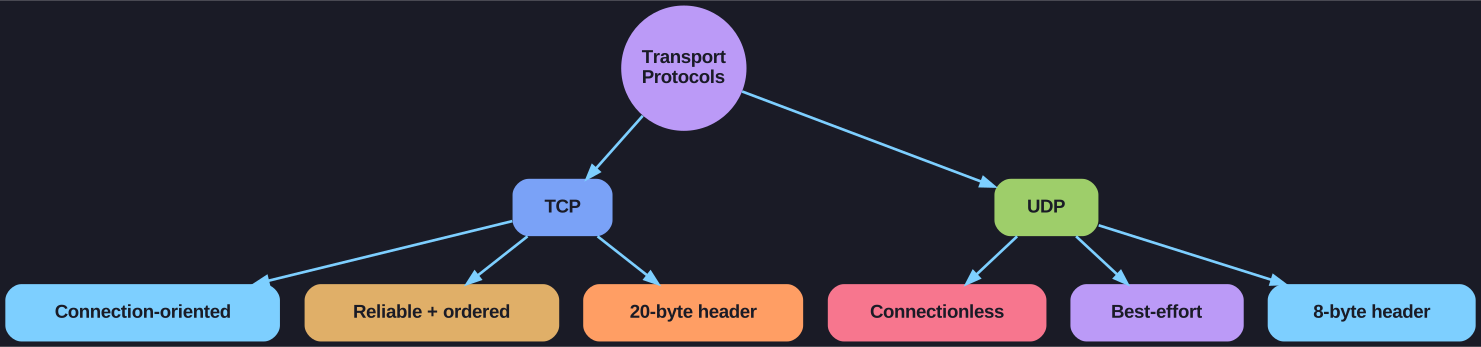
* TCP buys reliability and ordering with a heavier header; UDP stays connectionless and lightweight. *
TCP vs UDP Comparison:
| Feature | TCP | UDP |
|---|---|---|
| Connection | Connection-oriented | Connectionless |
| Reliability | Guaranteed delivery | Best-effort (unreliable) |
| Ordering | Same-order delivery | No ordering |
| Flow Control | Yes | No |
| Acknowledgment | Yes | No |
| Overhead | Higher (20+ bytes header) | Lower (8 bytes header) |
TCP (Transmission Control Protocol):
- Establishes session before sending data
- Numbers and tracks segments
- Acknowledges received data
- Retransmits unacknowledged data
- Like sending tracked packages
UDP (User Datagram Protocol):
- No connection establishment
- No acknowledgment of receipt
- No retransmission of lost data
- Like sending a non-registered letter
Go deeper:
 UDP and TCP: Comparison of Transport Protocols — PieterExplainsTech walks through the differences side by side.
- Transmission Control Protocol — Wikipedia reference for the reliable, connection-oriented side.
- User Datagram Protocol — Wikipedia reference for the lightweight, connectionless side.

Note saved — thanks!