Question
Why do network administrators need to understand binary, and what number systems are commonly used in networking?
Answer
Hosts, servers, and routers identify each other using binary addressing, so understanding it is needed to read and troubleshoot addresses. The three systems are binary (base 2), decimal (base 10), and hexadecimal (base 16).
Hosts, servers, and routers use binary addressing - understanding binary helps administrators identify and troubleshoot network issues.
Three number systems used in networking:
| Number System | Base | Digits Used | Common Use |
|---|---|---|---|
| Binary | 2 | 0, 1 | How devices process data |
| Decimal | 10 | 0-9 | Human-readable IPv4 |
| Hexadecimal | 16 | 0-9, A-F | IPv6 and MAC addresses |
Go deeper:
 Why Use Binary? — Computerphile — the physical reason digital devices count in two states rather than ten.
 Wikipedia — Binary number — base-2 fundamentals that underpin every address a device handles.

Note saved — thanks!
Question
How are IPv4 addresses structured in terms of bits and octets?
Answer
An IPv4 address is 32 bits split into 4 octets of 8 bits each; each octet is shown as a decimal 0-255 separated by dots (dotted decimal notation).
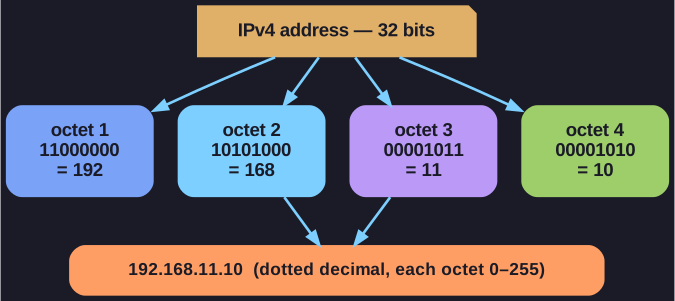
* 32 bits → four octets → dotted decimal: 11000000.10101000.00001011.00001010 = 192.168.11.10. *
IPv4 Address Structure:
- 32 bits total divided into 4 groups of 8 bits
- Each 8-bit group is called an octet
- Each octet is converted to decimal (0-255)
- Octets are separated by periods: Dotted Decimal Notation
Example:
Binary:     11000000.10101000.00001010.00001010
Decimal:    192.168.10.10
Key point: Routers and computers process IPv4 addresses in binary, but humans use dotted decimal for readability.
Go deeper:
- Wikipedia — IPv4 — the 32-bit address space, octets, and dotted-decimal notation in full.

Note saved — thanks!