Question
What are the four basic operations performed by the Network Layer?
Answer
Addressing end devices, encapsulation, routing, and de-encapsulation — these get a packet from the source host to the destination host across networks.
The Network Layer (Layer 3) performs four basic operations:
| Operation | Description |
|---|---|
| Addressing end devices | Devices must have unique IP addresses for identification |
| Encapsulation | Encapsulates Transport Layer segment into a packet with IP header |
| Routing | Directs packets toward the destination across networks |
| De-encapsulation | Receiving host removes IP header to pass segment to Transport Layer |
Key protocols: IPv4 and IPv6 are the principal Network Layer communication protocols.
Context: The Network Layer provides services for end devices to exchange data across networks. Network layer protocols forward transport layer PDUs (segments) between hosts.
Go deeper:
 IP Routing Explained (NetworkDirection) — animated walkthrough of how Layer 3 moves a packet between networks.
 Wikipedia — Network layer — the four functions (addressing, encapsulation, routing, de-encapsulation) in context.

Note saved — thanks!
Question
What happens during IP encapsulation at the Network Layer?
Answer
IP wraps the transport-layer segment in an IP header (adding source and destination addresses), creating a Layer 3 PDU called a packet.
Encapsulation is how the Network Layer hands off data to be routed: the Transport Layer's segment (TCP or UDP) becomes the payload, and IP prepends a header carrying the source and destination IP addresses. The result is a packet — the Network Layer's Protocol Data Unit (PDU). This matters because routing works entirely on the IP header: every router along the path reads those addresses to decide where to send the packet, while the wrapped segment is never touched until it reaches the destination host. Because the header is a separate wrapper, IP can switch between IPv4 and IPv6 without disturbing the Layer 4 segment inside, and (absent NAT) the source/destination addresses stay constant end to end so each hop sees the same forwarding information.
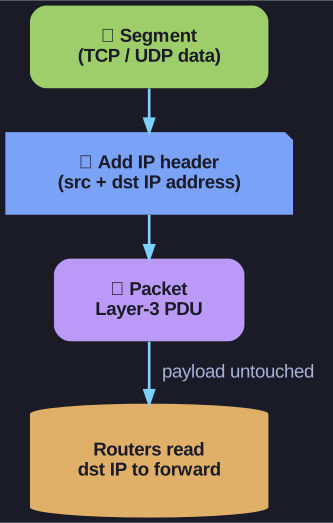
* The transport segment becomes the payload; IP adds a header to form the Layer-3 packet. *
IP Encapsulation process:
- IP encapsulates the Transport Layer segment (TCP or UDP)
- Adds an IP header containing source and destination addresses
- Creates a Network Layer PDU called a packet
Key characteristics:
- IP can use either IPv4 or IPv6 packet without affecting the Layer 4 segment
- The IP packet is examined by all Layer 3 devices (routers) as it traverses the network
- The IP addressing does NOT change from source to destination
Note: NAT (Network Address Translation) will change addressing, but that's covered in a later module.
Go deeper:
- PracticalNetworking — Packet Traveling — the full life of a packet, header by header, hop by hop.
- Wikipedia — Encapsulation (networking) — how each layer wraps the one above into its own PDU.
Note saved — thanks!