Question
What are the four main components of the UMTS network architecture?
Answer
UMTS consists of UE (User Equipment), UTRAN (radio access network), CN (Core Network), and the UMTS-PLMN (the operator's complete mobile network).
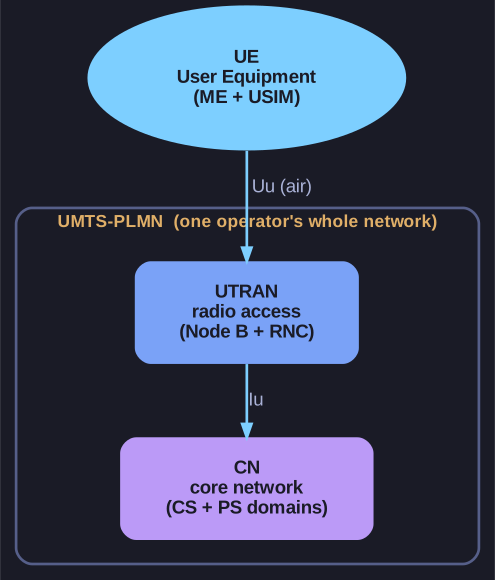
* The four pieces and how they nest: the UE talks to the UTRAN over the air, the UTRAN connects to the CN, and the PLMN is the operator boundary that encloses UTRAN + CN. *
| Component | Full Name | Role |
|---|---|---|
| UE | User Equipment | The mobile device (phone, laptop, router) — equivalent to GSM's MS |
| UTRAN | UMTS Terrestrial Radio Access Network | All radio-related infrastructure — handles the wireless connection |
| CN | Core Network | Fixed network for routing, switching, and subscriber management |
| UMTS-PLMN | Public Land Mobile Network | One network operator's complete UMTS network (its UTRAN + CN together) — each operator runs its own PLMN |
Key difference from GSM: UMTS was designed from the ground up to handle both voice and data as first-class citizens, whereas GSM was voice-first with data bolted on later (GPRS). This is reflected in the architecture having parallel circuit-switched and packet-switched domains in the core network.
Go deeper:
 3G UMTS Network Architecture (Electronics Notes) — walks the UE / UTRAN / core split element by element, including the CS and PS domains and shared HLR/AUC; richer than the encyclopedia overview.
- UMTS (Wikipedia) — kept for the canonical standard overview and its architecture diagram.

Note saved — thanks!
Question
What does the UE (User Equipment) consist of in UMTS?
Answer
The UE consists of the ME (Mobile Equipment) — the physical hardware — and the USIM (UMTS Subscriber Identity Module) — a smartcard containing all subscriber-specific data.
ME (Mobile Equipment):
- The physical device: phone, USB modem, laptop with UMTS module, mobile hotspot
- Contains the radio transceiver, processor, display, etc.
USIM (UMTS Subscriber Identity Module):
- A smartcard (the SIM card) that stores all user-related data
- Contains: subscriber identity (IMSI), authentication keys, phone book, service preferences
- Portable — you can move your USIM to a different device and keep your identity/number
- More advanced than GSM's SIM — supports mutual authentication (the network proves itself to the phone too, not just the other way around)
Compared to GSM: UE = MS (Mobile Station). The terminology changed, but the concept is the same. The key upgrade is the USIM's enhanced security capabilities — GSM's SIM only authenticated the user to the network, while USIM also authenticates the network to the user, preventing fake base station attacks.
Go deeper:
- USIM (Wikipedia) — the USIM application on the UICC smartcard: how it stores the IMSI and keys and adds mutual authentication over GSM's SIM.

Note saved — thanks!