Question
When a subscriber roams, what roles do the home network, the visited network, and the SIM card play?
Answer
The home network (where your contract lives) stores your identity and service data in its HSS; the visited network is any other network that serves you thanks to roaming agreements; the SIM carries the global identification information that links you to your home network.
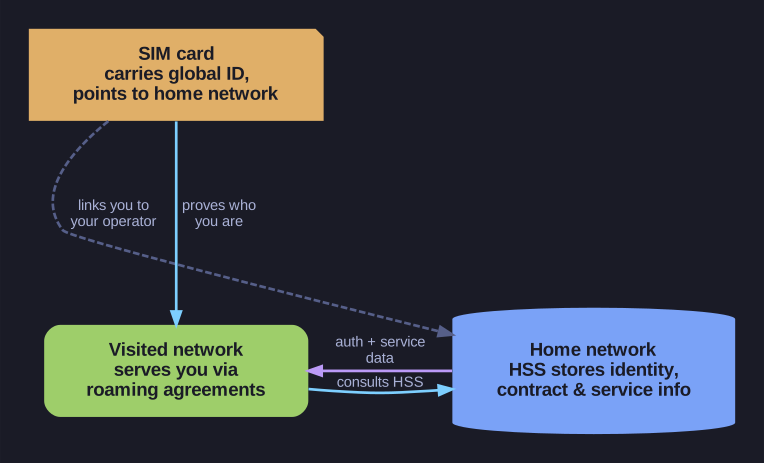
* The roaming triangle: the SIM proves identity, the visited network serves you, the home HSS stays the source of truth. *
The three actors:
| Actor | Role |
|---|---|
| Home network | Your contractual operator (e.g., Swisscom or Salt — depending on your contract). Its HSS stores identification, contract, and service information |
| Visited network | Any network other than the home network. Its provider holds contracts and service agreements with other networks to allow visiting subscribers access |
| SIM card | Carries the global identification information that tells any network who you are and where your home network is |
Why this triangle matters: roaming only works because (a) your SIM proves your identity anywhere, (b) the visited network has a business agreement with your home operator, and (c) your home HSS remains the single source of truth that the visited network consults.
Mobility refresher: the challenge scales from no mobility (stationary user, one access point) through disconnecting and reconnecting while moving, up to high mobility (connections maintained seamlessly across networks — the mobile phone case). More mobility = more network functionality required, but more comfort for the user.
Go deeper:
 Roaming (Wikipedia) — home vs visited network and the inter-operator agreements + AAA billing that let your SIM work abroad.

Note saved — thanks!
Question
How does GSM route an incoming call to a roaming mobile subscriber (indirect routing)?
Answer
The call is first routed to the subscriber's home network; the home MSC consults the HLR to obtain a roaming number for the mobile in the visited network, then sets up a second call leg to the visited MSC, which completes the call through the local base station.
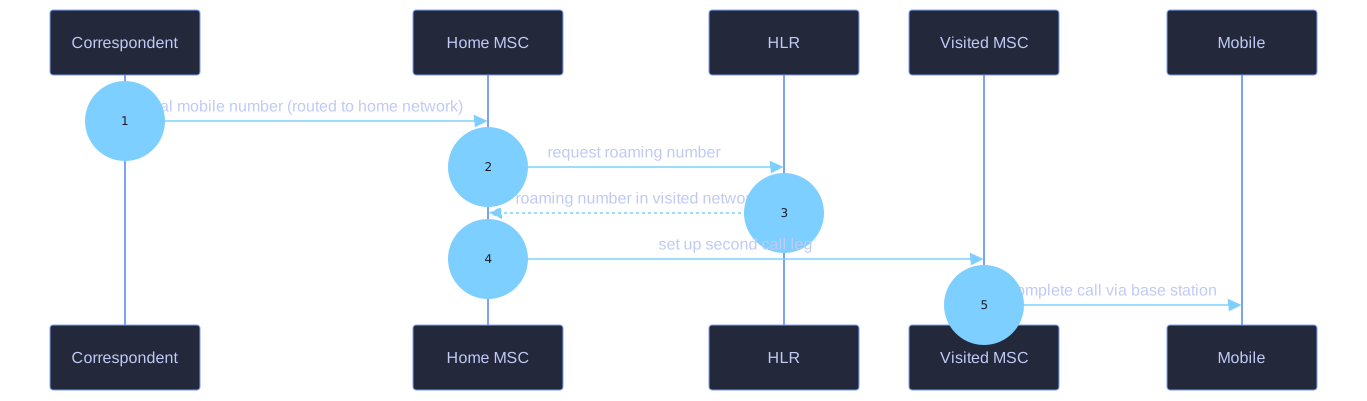
* GSM indirect routing: home MSC gets a roaming number, then a second leg. *
The setup: different cellular networks, operated by different providers, are interconnected via the wired public telephone network — each network's MSCs form the bridge.
The four steps of GSM indirect routing:
- Call routed to home network — the correspondent dials the mobile number; the PSTN routes the call to the subscriber's home MSC (the number identifies the home network, not the current location)
- Home MSC consults the HLR — and gets the roaming number of the mobile in the visited network (the HLR knows the current location because of registration)
- Home MSC sets up the second leg of the call to the MSC in the visited network
- The visited MSC completes the call through the base station to the mobile
The "indirect" part: even if the correspondent stands next to you in Rome, the call still travels via your Swiss home network first — the classic triangle-routing cost of indirect routing, traded for simplicity (the caller needs to know nothing about your location).
Tip: This is the GSM-concrete version of the generic home-agent/foreign-agent model: HLR + home MSC = home agent role, VLR + visited MSC = foreign agent role.
Go deeper:
- Network switching subsystem (Wikipedia) — the GMSC querying the HLR for a roaming number (MSRN) to set up the second call leg.
Note saved — thanks!