Question
What are the key similarities and differences between mobile networks and the wired internet?
Answer
Mobile networks share the same edge/core structure and protocols (HTTP, DNS, TCP/IP) as the wired internet, but add wireless transmission, built-in mobility, SIM-based identity, and roaming.
Similarities:
- Edge network + core network architecture; the core uses the same general networking technology
- Uses the same protocols and design patterns: HTTP, DNS, TCP, UDP, IP, NAT, Ethernet, tunneling — and modern cores also borrow control-plane / user-plane separation and SDN (Software-Defined Networking)
- A global mobile network is a network of networks — just like the internet
- Mobile networks are connected to the wired internet
Differences:
| Aspect | Wired Internet | Mobile Network |
|---|---|---|
| Physical layer | Cable / Wi-Fi (Ethernet, fiber, WLAN) | Cellular Radio Access Technology (RAT) — licensed-spectrum radio, not WLAN |
| Mobility | Not built-in | Integral part — handover, location tracking |
| Identity | IP address (dynamic) | SIM card — persistent, hardware-bound identity |
| Business model | ISP subscription | Carrier subscription with roaming agreements |
| Authentication | Login/password | SIM-based crypto — automatic, everywhere |
| Access abroad | Same ISP everywhere | Roaming in visited networks with inter-provider billing |
Key insight: The mobile network had to solve problems the internet never faced — how to maintain a connection while moving at 200 km/h, how to authenticate a user automatically without typing a password, and how to bill across different operators in different countries.
Go deeper:
 Internet protocol suite (Wikipedia) — the TCP/IP/HTTP/DNS layered stack the mobile core reuses, and the end-to-end edge-vs-core principle.
- Cellular network (Wikipedia) — what the mobile side adds: cells, frequency reuse, base stations, handover and the MSC.

Note saved — thanks!
Question
What are the basic components of any mobile network architecture, regardless of generation?
Answer
Every mobile architecture has cells (coverage areas), base stations (radio towers), mobile subscribers (phones), an air interface (radio protocol), and an MSC (switching center connecting to the wired network).
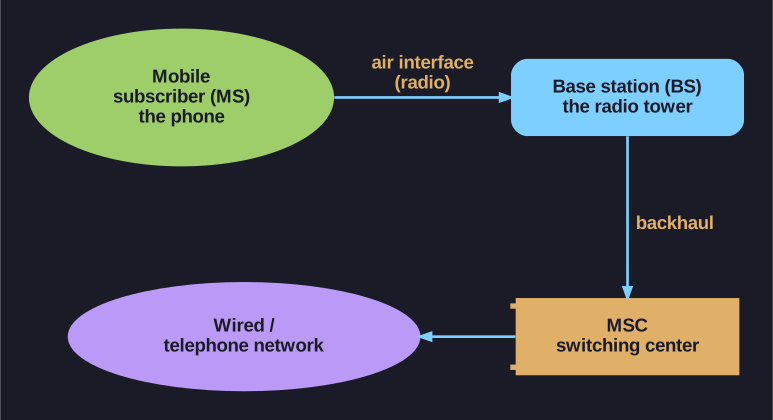
* The constant skeleton across every generation: phone → air interface → base station → switching center → wired network. *
The universal building blocks:
| Component | Role |
|---|---|
| Cell | A geographic region covered by one base station — analogous to a WiFi access point's coverage area |
| Base station (BS) | The radio tower — handles the wireless connection to mobile devices |
| Mobile subscriber (MS) | The phone/device that connects over the air interface |
| Air interface | The protocol between MS and BS — defines the physical and data link layer |
| MSC | Mobile Switching Center — connects the radio network to the wired telephone network, manages call setup and mobility |
What changes between generations:
- The air interface technology (FDMA → TDMA → CDMA → OFDMA)
- The core network architecture (circuit-switched → packet-switched → all-IP)
- The data rates (9.6 kbps → 42 Mbps → 1 Gbps → 20 Gbps)
- The component names (BTS/BSC → NodeB/RNC → eNodeB → gNodeB)
But the fundamental pattern — cells with base stations, connected to a switching core — has remained constant from 1G through 5G.
Go deeper:
- Cellular Network Basics — architecture (Electronics Notes) — a generation-agnostic walk through BTS → BSC → MSC plus the HLR/VLR registers, showing the same edge/core skeleton every generation reuses.
- Network switching subsystem (Wikipedia) — what the MSC actually does: call setup and teardown, routing, handover and billing, plus the HLR/VLR/AuC registers behind it.
Note saved — thanks!