Question
Who pioneered wireless data transmission, and what did he demonstrate?
Answer
Guglielmo Marconi performed the first wireless radio transmission in 1895, calling it "telegraphy without cables."
Marconi was just 21 years old when he demonstrated that electromagnetic waves could carry information without physical wires. His first successful experiment transmitted signals from the Isle of Wight, England, to a tugboat 28 km out at sea.
What made this revolutionary wasn't just the technology. It was the proof of concept that information could travel through thin air. Before Marconi, every form of long-distance communication required a physical connection, whether copper wire for telegraph or undersea cables.
Key milestone: This 1895 demonstration is considered the birth of wireless communication, the ancestor of every mobile network we use today.
Tip: Think of Marconi as the "grandfather of mobile." No Marconi, no mobile phones.
Go deeper:
 Guglielmo Marconi (Wikipedia) — full biography with dates and milestones of his early wireless experiments.

Note saved — thanks!
Question
What was Marconi's 1907 milestone, and why did it matter commercially?
Answer
On October 17, 1907, Marconi opened the first commercial transatlantic wireless telegraph service between Nova Scotia, Canada, and Ireland.
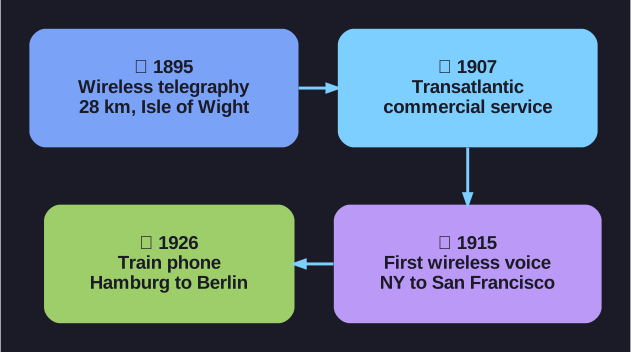
* Wireless pioneer milestones, 1895 to 1926. *
This was a game-changer for several reasons. Before this, transatlantic communication depended entirely on fragile undersea telegraph cables that were expensive to lay and frequently broke. Marconi's wireless service provided a reliable alternative.
The base stations required for this were massive, with antennas 30 to 100 meters tall. Nothing like the compact cell towers we see today.
The progression tells a story:
- 1895: 28 km, proof of concept.
- 1907: Transatlantic, commercial viability.
- 1915: First wireless voice communication between New York and San Francisco.
- 1926: First telephone on a train between Hamburg and Berlin, using wires parallel to the railway tracks as antennas.
Each step pushed wireless communication further: longer range, richer content, and greater mobility.
Go deeper:
- History of mobile phones (Wikipedia) — situates the 1907 transatlantic service and the 1915/1926 voice milestones in the arc from pre-cellular radiotelephony to today's networks.
Note saved — thanks!