Question
What makes securing a mobile network fundamentally harder than securing a wired or even a WLAN network?
Answer
Transmission happens over a public, shared medium (air), subscribers are mobile with no fixed connection, and they constantly switch base stations — so the network must identify, track, and bill a moving target it can never physically pin down.
The core difficulties:
- Public medium: the air interface is open — anyone in range can receive the signal, so confidentiality cannot be assumed from physical isolation (unlike a cable)
- Mobility: subscribers move, and connections are not fixed to a port or line
- Changing base stations: a user roams across many base stations and transmission resources
The mobile network's answers:
- Unique identification of a subscriber (so a connection can be attributed)
- Unique identification of a device
- Tracking of the user via Location Identifiers (LAC/TAC) across base stations
- A mobile anchor: the home-network provider handles billing and authentication via the HLR
The hard question: how do we keep TCP sessions and encryption alive while moving fast between base stations by car, bus, or train? Every security mechanism in GSM/LTE must survive that mobility — which is exactly why mobile security is its own discipline.
Go deeper:
 Cellular network (Wikipedia) — the cells-and-handover model that creates the moving target: frequency reuse, mobility management, handoff.
Note saved — thanks!
Question
What are the three established security techniques in a mobile network, and what is the first attack vector they defend?
Answer
The three techniques are: (1) a SIM card with an identification number and key for authentication, (2) encryption of the communication, and (3) position anonymization via a temporary subscriber identity. They defend the link between the handset and the point where traffic enters the fixed network.
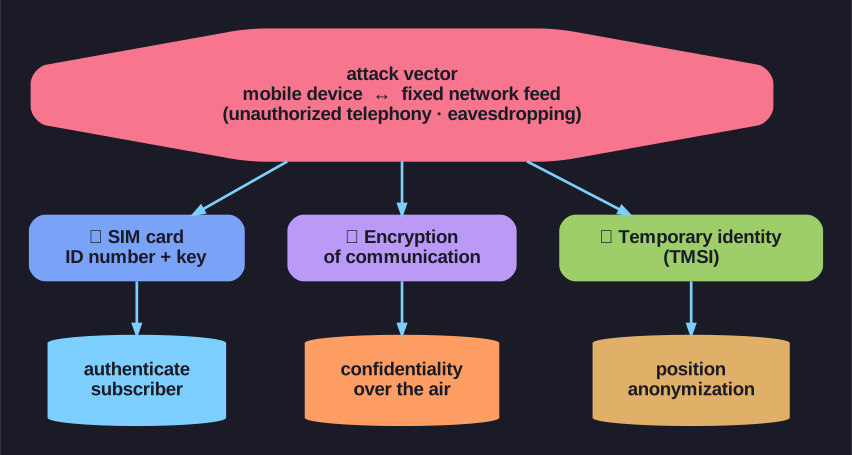
* The three GSM security techniques and what each provides. *
The first attack vector: the stretch between the mobile device and the feed into the fixed network (i.e., the radio path to/through the base station). The two classic threats there are:
- Unauthorized telephony (impersonating a paying subscriber)
- Eavesdropping on the transmission
The three established defenses:
| # | Technique | Purpose |
|---|---|---|
| 1 | SIM card with identification number + key | Authentication of the subscriber |
| 2 | Encryption of the communication | Confidentiality over the air |
| 3 | Temporary subscriber identity | Position anonymization against third parties |
Why temporary identities matter: if the phone always broadcast its permanent identity (IMSI), anyone listening could build a movement profile. A rotating temporary identity (TMSI) breaks that linkability — defense #3 protects privacy, not just confidentiality.
Go deeper:
- GSM (Wikipedia) — the system that introduced SIM authentication, over-the-air encryption, and TMSI, and the architecture they sit in.
Note saved — thanks!