Question
What is the cellular concept in mobile networks, and what two problems does it solve?
Answer
The cellular concept (McDonald, AT&T, 1978) divides a coverage area into smaller cells, each served by its own base station, to overcome spectrum scarcity and transmit power limitations.
The two core challenges:
- Spectrum scarcity — radio frequencies are a limited resource; you can't just assign every user a unique frequency across a huge area
- Limited transmit power — a single antenna can't cover an entire city at high data rates; signal strength drops with distance
The solution — segmentation into cells — brings key advantages:
- Full coverage of large areas by tiling many small cells
- Frequency reuse — the same frequencies can be reused in non-adjacent cells, massively increasing capacity
- Handover — seamless transfer of a connection when a user crosses a cell boundary
- Location-based services — knowing which cell a user is in enables positioning
A radio cell (Funkzelle) is the area where a base station's signal can be received and decoded error-free. Every cell has a unique Cell-ID.
Tip: Think of cells like a honeycomb — each hexagon reuses the same set of colors (frequencies) as long as no two adjacent hexagons share one. This is essentially the graph coloring problem applied to radio planning.
Go deeper:
 Basic cellular system concept (Electronics Notes) — walks through why cells exist, frequency re-use, cell sizes (macro/micro/pico/femto) and sectorization in one place.
Note saved — thanks!
Question
How does frequency reuse work, and why is it compared to the three-color map problem?
Answer
Frequency reuse means assigning the same frequency group to cells that are far enough apart that they don't interfere — the planning challenge is exactly the map-coloring problem: give neighboring cells different "colors" (frequencies) using as few groups as possible.
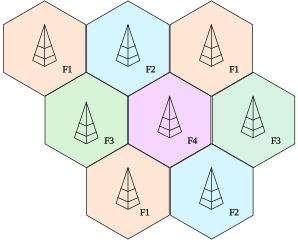
* Frequency reuse across a hexagonal cell cluster. — Andrew pmk, CC BY-SA 2.5, via Wikimedia Commons. *
Spectrum is scarce, so you cannot give every cell its own private frequencies. Instead the available frequencies are split into a small number of groups (often called a reuse cluster of size N), and each cell is assigned one group. Because radio signals fade with distance, two cells using the same group can coexist as long as there is enough separation between them.
The map-coloring (graph coloring) analogy:
- Picture the honeycomb of hexagonal cells. Two cells that touch are "adjacent."
- You must color the map so that no two adjacent cells share a color — each color is a frequency group.
- The classic three-color / four-color map problem asks how few colors suffice. For a regular hexagonal grid you can reuse frequencies with a small cluster, which is what makes cellular networks capacity-efficient.
Why it matters:
- Smaller reuse cluster (fewer groups) → each frequency is reused more often → more total capacity.
- But pack reusing cells too close → co-channel interference rises. So reuse distance is the central tradeoff in radio planning.
Tip: "Reuse distance" is the geographic version of "don't put the same color on neighboring countries." Shrinking the cluster is like coloring a map with fewer crayons — efficient, but risky if two same-color regions end up touching.
Go deeper:
 Frequency reuse, cell splitting & handoff (EzEd Channel) — animated walk-through of reuse clusters and how shrinking cells raises capacity.
- Basic cellular system concept (Electronics Notes) — the 7-cell cluster, reuse distance and the capacity-vs-interference trade-off in plain prose.
- Cellular network (Wikipedia) — frequency reuse, reuse factors (1/3, 1/7, …) and co-channel interference, with the hexagon model.

Note saved — thanks!