Question
What are the four layers of the TCP/IP network model?
Answer
Application, Transport, Internet, Link — four layers, each handling one job from user data down to the physical wire.
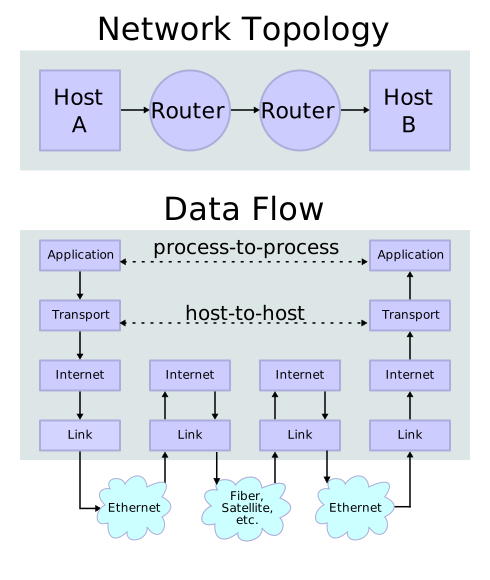
* How the TCP/IP layers operate end-to-end — upper layers run only at the two hosts, lower layers at every hop. — Kbrose, CC BY-SA 3.0 / GFDL, via Wikimedia Commons. *
The TCP/IP model splits networking into four layers so each can be designed and changed independently. As data is sent, it travels down the stack — each layer wraps the data with its own header (encapsulation); on receipt it travels back up, each layer stripping its header.
| Layer | Its job | Example protocols |
|---|---|---|
| Application | What the user/app actually wants done | HTTP, HTTPS, FTP, SSH, DNS, DHCP, SMTP |
| Transport | End-to-end delivery between processes (ports) | TCP, UDP |
| Internet | Routing packets across networks (logical addresses) | IPv4, IPv6, ICMP |
| Link | Moving frames over one physical hop | Ethernet, Wi-Fi, ARP, PPP, MAC |
The payoff of layering: the Application layer doesn't care whether the Link layer is fibre or Wi-Fi, and the Internet layer routes the same regardless of which app generated the data.
Mapping to OSI (the other common model): TCP/IP Application ≈ OSI layers 5–7, and TCP/IP Link ≈ OSI layers 1–2.
Mnemonic: "All Teenagers Ignore Lectures" (Application, Transport, Internet, Link).
Go deeper:
 Internet protocol suite (Wikipedia) — the four layers (Application/Transport/Internet/Link), encapsulation, and the OSI mapping.
Note saved — thanks!
Question
What is dual-stack mode in Linux networking?
Answer
Dual-stack means the host runs IPv4 and IPv6 in parallel on the same interfaces, so it can reach both IPv4-only and IPv6-only peers.
The internet is mid-migration: IPv4 was the dominant protocol as of the mid-2020s, but its ~4.3 billion addresses ran out, and IPv6 is the long-term replacement. You can't flip everything over at once, so the practical bridge is to speak both at the same time — that's dual-stack.
Why it's the default approach:
- a dual-stack host talks to legacy IPv4-only services and newer IPv6-only ones
- it allows a gradual, no-flag-day transition — networks add IPv6 without dropping IPv4
- both stacks coexist on one interface, each with its own address(es) and routing
Red Hat Enterprise Linux ships in dual-stack mode out of the box, and most modern Linux distributions do the same — no special configuration is needed to have both.
Tip: when a host has both, applications generally try IPv6 first and fall back to IPv4 (the "Happy Eyeballs" approach), so connectivity is preserved either way.
Note saved — thanks!