Question
Who created Linux and when was it first announced?
Answer
Linus Torvalds, then a Finnish student, announced Linux on 25 August 1991.
He posted to the comp.os.minix newsgroup with the now-famous understatement: "I'm doing a (free) operating system (just a hobby, won't be big and professional)." The context matters: real Unix ran on expensive university machines, and the only thing close to it for a home PC was MINIX, a teaching OS he found too limited and too restrictively licensed to build on.
So his goal was concrete and personal — get a Unix-like system running on his own i386 PC, free for anyone to use and modify. That "free and modifiable" choice is what turned a hobby into a global project: thousands of developers could pile in, which a single hobbyist could never have matched.
- The name = "Linus' Unix" (originally he wanted to call it Freax).
- It began as one person's side project and now runs most servers, all the top supercomputers, and (via Android) most phones.
Tip: Anchor the date as "91." GNU started in 83, the GPL in 89, Linux in 91 — the building blocks lined up over a single decade.
Go deeper:
 History of Linux (Wikipedia) — Torvalds' 25 Aug 1991 comp.os.minix announcement and the full milestone timeline.
Note saved — thanks!
Question
What is the Linux Kernel and what are its main responsibilities?
Answer
The kernel is the operating system's core — the privileged layer that controls the hardware and shares it out fairly among all running programs.
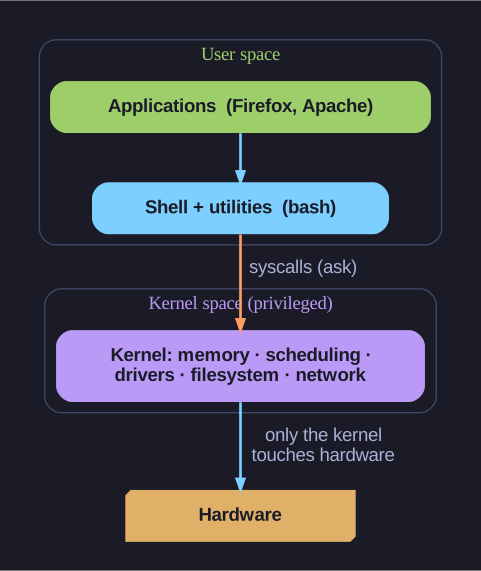
* User-space programs must ask the kernel via syscalls; only the privileged kernel touches the hardware. *
Think of the kernel as the resource manager that no application is allowed to bypass. Ordinary programs run in "user space" and can't touch hardware directly; when they need RAM, disk, or network they ask the kernel, which arbitrates. This is what stops one buggy program from corrupting another's memory or hogging the whole CPU.
| Responsibility | What it actually does |
|---|---|
| Memory management | Hands each process its own protected slice of RAM |
| Multitasking (scheduling) | Rapidly switches the CPU between processes so they appear to run at once |
| Device drivers | Speaks the specific language of each piece of hardware |
| Network management | Moves packets in and out, runs the TCP/IP stack |
| Filesystem management | Turns raw disk blocks into named files and directories |
Important: The kernel by itself does nothing visible — it's an engine with no steering wheel. You need system programs like a shell (bash), an init system, and utilities to actually drive it. That's the whole reason "Linux" in everyday speech means kernel plus all that surrounding software.
Mnemonic: "Kernel = King of Hardware" — every hardware request goes through it.
Note saved — thanks!