Question
What key principle classifies asymmetric algorithms by whether their one-way function has a trapdoor?
Answer
"Some asymmetric algorithms rely on one-way functions WITH trapdoor, others on one-way functions WITHOUT trapdoor."
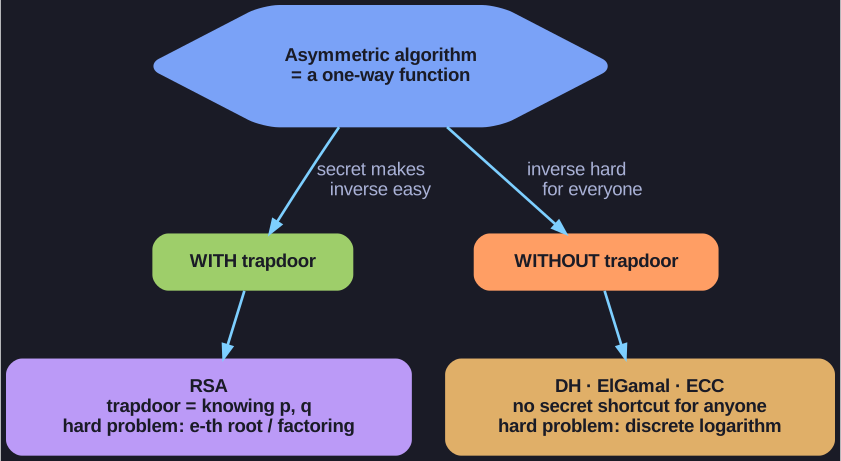
* With a trapdoor, a secret shortcut makes the inverse easy for its owner; without one, the inverse is hard for everyone. *
This fundamental distinction divides all public-key cryptography:
| Type | Trapdoor? | Example | Hard Problem |
|---|---|---|---|
| RSA | Yes — knowing $p, q$ | Encryption + Signatures | e-th root mod N (factoring) |
| Diffie-Hellman | No | Key exchange only | Discrete logarithm mod p |
| ElGamal | No | Encryption + Signatures | Discrete logarithm mod p |
| ECC | No | Encryption + Signatures | Discrete logarithm on curves |
With trapdoor means: there exists a secret (the factorization $N = p \cdot q$) that makes the inverse computation easy. Without it, the inverse is infeasible.
Without trapdoor means: the inverse is hard for everyone — there is no shortcut. Security relies on the mathematical structure, not a secret shortcut.
Go deeper:
 Trapdoor function (Wikipedia) — the precise definition of "easy one way, easy back only with a secret".
- Public-key cryptography (Wikipedia) — the whole family this distinction organises.
![The idea of trapdoor function. A trapdoor function f with its trapdoor t can be generated by an algorithm Gen. f can be efficiently computed, i.e., in probabilistic polynomial time. However, the computation of the inverse of f is generally hard, unless the trapdoor t is given.[1]](https://upload.wikimedia.org/wikipedia/commons/thumb/8/8f/Trapdoor_permutation.svg/960px-Trapdoor_permutation.svg.png)
Note saved — thanks!
Question
What mathematical problem does RSA's security rely on, and who invented it?
Answer
RSA was invented by Rivest, Shamir, and Adleman in 1978. Its security relies on the difficulty of factoring large numbers $N = p \cdot q$ and computing e-th roots mod N.
The RSA hard problem:
- Forward: $c \equiv m^e \mod N$ — easy (square-and-multiply)
- Inverse: $m \equiv \sqrt[e]{c} \mod N$ — hard without knowing $p$ and $q$
The factoring connection:
- If you can factor $N = p \cdot q$ → you can compute $\varphi(N) = (p-1)(q-1)$ → you can compute $d \equiv e^{-1} \mod \varphi(N)$ → you can decrypt
- Factoring ⇒ e-th root (proven)
- e-th root ⇒ factoring (believed but not proven)
- There might be a way to compute e-th roots without factoring — but nobody has found one
Current recommendations (BSI 2023): RSA modulus $N$ must be at least 3000 bits (practically 3072 bits). Primes $p, q$ are each ~1536 bits (~462 decimal digits), making $N$ about $10^{1000}$.
Go deeper:
- Rivest, Shamir & Adleman — the original 1978 paper (PDF) — "A Method for Obtaining Digital Signatures and Public-Key Cryptosystems", where it all began.
- RSA cryptosystem (Wikipedia) — full scheme, history and attacks.
- The RSA problem (Wikipedia) — why RSA security is the e-th-root problem, not exactly factoring.
Note saved — thanks!