Question
A common claim in cryptography is that key length is NOT the only security criterion. Why not — what else can break a system whose algorithm and key size are both strong?
Answer
A large, correct key only secures the math. Real systems still fall through side-channels, badly-protected keys, software (rather than hardware) key storage, a weak first key exchange, broken authentication protocols, and attacks that never touch the wire at all.
A 256-bit AES key or a 3072-bit RSA key makes brute force hopeless — but attackers rarely fight the math. Here is how a "strong-key" system still gets broken:
- Side-channel attacks — timing, power draw or electromagnetic leakage reveal the key around the cipher, without breaking it.
- Poorly protected keys — a 2048-bit RSA private key guarded by a 6-digit password is only as strong as those 6 digits.
- Keys/algorithms in software, not a security module — if the crypto runs in the PC's memory instead of dedicated hardware (HSM, smartcard), the key can be read out.
- A weak initial key exchange — "trust on first use" (TOFU) or plain FTP lets an attacker sit in the middle during setup, before any strong key is agreed.
- Weak or wrong authentication protocols — if you can't be sure who holds the other key, its size is irrelevant.
- Attacks off the communication path — the classic Alice–Bob model only considers on-the-wire attacks; the endpoint, the user, or the supply chain are often the real target.
A sharper version of the same point: the size of a brute-force attack says nothing about an algorithm's security. 104-bit RC4 is brute-force-proof, yet it can be broken on home equipment because the algorithm is weak. Security is the weakest link in the whole chain — never just the biggest number in it.
Go deeper:
 Side-channel attack (Wikipedia) — how timing, power, and EM leakage recover a key without ever breaking the cipher.

Note saved — thanks!
Question
What minimum key sizes does the German BSI currently recommend for the main cryptographic algorithms, and what security level do they target?
Answer
AES 128+ bits, RSA/DH 3072+ bits, ECC 256+ bits, hash-for-signatures 256+ bits — all chosen to give roughly a 128-bit security level (the point where brute force is physically hopeless).
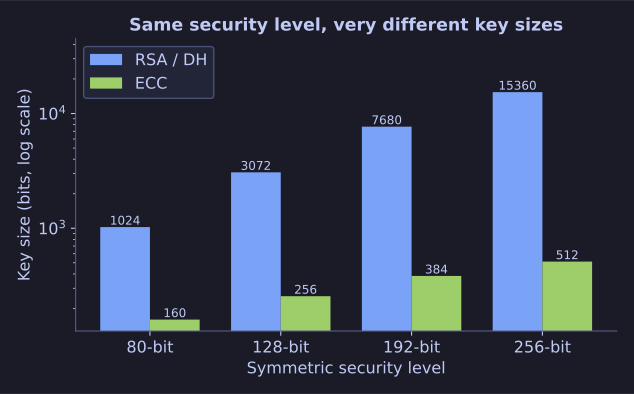
* For equal security, RSA/DH keys grow far faster than ECC keys (log scale). *
The BSI (Germany's Federal Office for Information Security) publishes yearly guidance in Technical Guideline TR-02102-1; these are its current recommendations. The unifying idea is that every row is dimensioned to the same ~128-bit security level — so the numbers look wildly different only because each problem (brute force vs. factoring vs. discrete log) resists attack differently.
| Algorithm | Minimum Key Size | Security Level |
|---|---|---|
| AES | 128 bits (192/256 better) | 128 bits |
| RSA | 3072 bits (since 2023) | ~128 bits |
| DH / DSA | 3072 bits | ~128 bits |
| ECC | 256 bits (384/512 better) | ~128 bits |
| SHA-2/3 for signatures | 256-bit output | min. 240-bit hash → 120-bit collision |
| HMAC | SHA-2 or SHA-3 | min. 256-bit output |
The hash rule has a subtle floor: since 2023 the minimum hash size is 240 bits, which knocks out 224-bit hashes (and 224-bit ECC, which can only sign a 224-bit hash) — so 256 bits is effectively the practical minimum.
Equivalence table:
| Symmetric | RSA/DH | ECC |
|---|---|---|
| 80 | 1024 | 160 |
| 128 | 3072 | 256 |
| 192 | 7680 | 384 |
| 256 | 15360 | 512 |
Key observation: Doubling the symmetric key size (128 → 256-bit security) takes RSA from 3072 → 15360 bits (≈5×) but ECC only from 256 → 512 bits (2×). This is why ECC scales much better.
Go deeper:
 keylength.com — compare key-size recommendations — pick a target year and see every standards body's recommended sizes side by side.
- Key size (Wikipedia) — the security-level equivalence between symmetric, RSA and ECC keys.
Note saved — thanks!