Question
What are the 8 attacks in the classic cryptographic communication model?
Answer
There are 8 fundamental attacks: eavesdropping, modifying, inserting, replaying, deleting messages, plus denying sending, denying receiving, and masquerading as someone else.
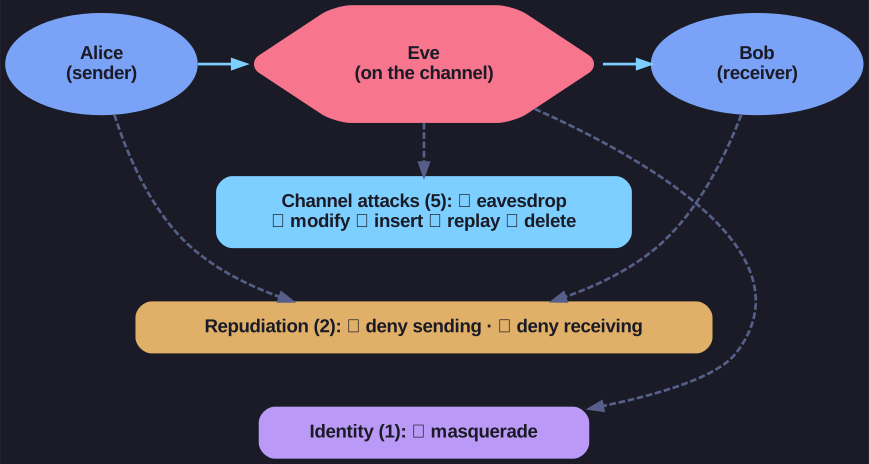
* The classic Alice / Eve / Bob model: 5 channel attacks, 2 repudiation attacks, 1 identity attack. *
The attacks target a channel between sender Alice (A) and receiver Bob (B), with attacker Eve (E):
| # | Attack | Target |
|---|---|---|
| 1 | Eavesdropping (Abhören) | Confidentiality |
| 2 | Modifying (Verändern) | Data integrity |
| 3 | Inserting (Einfügen) | Data authenticity |
| 4 | Replaying (Wiedereinspielen) | Freshness |
| 5 | Deleting (Löschen/Unterdrücken) | Availability |
| 6 | Non-repudiation of origin (Abstreiten Senden) | Accountability of sender |
| 7 | Non-repudiation of receipt (Abstreiten Empfang) | Accountability of receiver |
| 8 | Masquerade (Vortäuschen Identität) | User authenticity |
Tip: Group them as: 5 channel attacks (1-5), 2 repudiation attacks (6-7), 1 identity attack (8).
Go deeper:
 Information security (CIA triad) — the confidentiality/integrity/availability goals these attacks target.

Note saved — thanks!
Question
Which security requirements map to which attacks in the classic crypto model?
Answer
Three security requirements — confidentiality, data integrity/authenticity, and user authenticity — each protect against specific subsets of the 8 attacks.
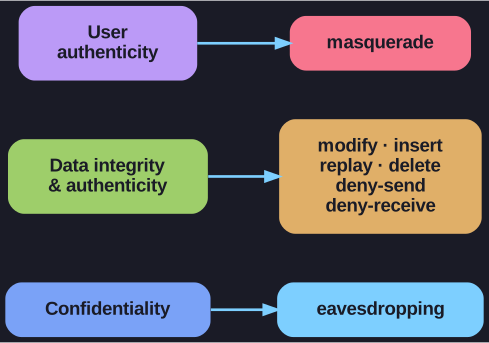
* Each requirement defends a specific subset of the 8 attacks. *
| Security Requirement | Protects Against |
|---|---|
| Confidentiality | Eavesdropping |
| Data Integrity & Authenticity | Modifying, Inserting, Replaying, Deleting, Non-repudiation of origin, Non-repudiation of receipt |
| User Authenticity | Masquerade |
Notice that data integrity/authenticity covers the largest group (6 attacks). This is why MAC and digital signatures are so central to cryptographic protocols — they handle most of the threat landscape.
What about availability? It's deliberately absent from this model. The classic crypto model scopes the goals cryptography can enforce on a message — confidentiality, integrity/authenticity, and user authenticity. Availability (keeping a service reachable, surviving a DoS) is a systems/network property that crypto can't deliver: encrypting or signing a message does nothing to stop it being dropped or a server being flooded. It's part of the broader CIA triad, but it sits outside the cryptographic requirements.
Go deeper:
- Information security — how security goals partition the threat space.
Note saved — thanks!