Question
How do Kryptologie, Kryptografie, and Kryptoanalyse relate to each other?
Answer
Cryptology is the umbrella discipline; cryptography is the constructive half (build secure schemes) and cryptanalysis is the destructive half (break them).
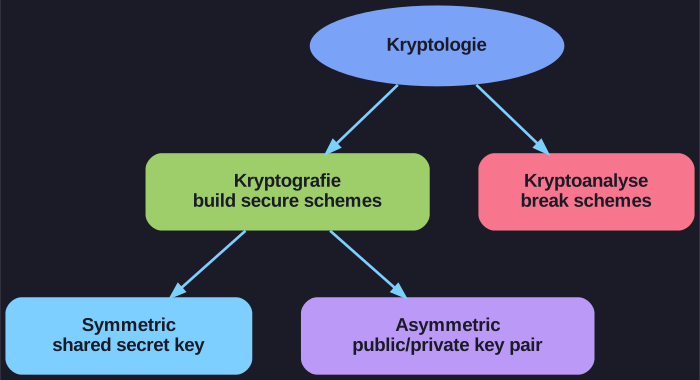
* Cryptology splits into cryptography (build secure schemes) and cryptanalysis (break them); cryptography splits again into symmetric and asymmetric. *
                  Kryptologie
                 /            \
        Kryptografie      Kryptoanalyse
        /         \
Symmetrische    Asymmetrische
Kryptografie    Kryptografie
- Kryptografie — designs and analyses systems for confidentiality, integrity, authenticity. Split into symmetric (shared secret key) and asymmetric (public/private key pair).
- Kryptoanalyse — studies attacks on cryptographic schemes: ciphertext-only, known-plaintext, chosen-plaintext, side-channel, etc. Both attackers and defenders need it: attackers to break; defenders to know what to defend against.
Tip: A textbook line — "a defender who doesn't understand cryptanalysis can't tell a secure scheme from a snake-oil one." That's why crypto courses cover attacks alongside constructions.
Go deeper:
 Cryptography (Wikipedia) — the whole field these two branches make up, and where symmetric vs asymmetric sit within it.

Note saved — thanks!
Question
What is Kerckhoffs' Principle, and why is it the default for modern cryptography?
Answer
A cryptosystem should remain secure even if everything about it except the key is publicly known.
The Dutch cryptographer Auguste Kerckhoffs published it in 1883. Translated to modern terms: the algorithm, protocol, implementation, parameters, and modes are all assumed public. Only the key is secret.
Why this is the default:
- Algorithms can't stay secret in practice — software gets reverse-engineered, hardware gets decapped, employees leak, vendors publish. "Security through obscurity" of the algorithm has failed every single time it's been tried at scale (A5/1 in GSM, content scramble in DVDs, Mifare Classic, …).
- Public algorithms get reviewed. AES, RSA, ECC, SHA-2 all went through years of public cryptanalysis before being trusted. A secret algorithm has been reviewed only by its (small) author team.
- Key rotation is cheap; algorithm rotation is expensive. If only the key is secret, a compromise just means rotating keys. If the algorithm was secret too, you have to rebuild the whole system.
Tip: Whenever you see "we use our own proprietary encryption", that's a red flag — it's the opposite of Kerckhoffs and the opposite of what every modern security standard recommends.
Go deeper:
- Kerckhoffs's principle (Wikipedia) — the 1883 origin and why "only the key is secret" became the modern default.
Note saved — thanks!