Question
What is a management system in the ISO 27000 sense?
Answer
A management system is a framework of resources (organisational structures, policies, planning activities, responsibilities, methods, processes) that an organisation uses systematically to reach its objectives.
The formal definition from DIN EN ISO/IEC 27000:2017, Kap. 3.2.5:
"A management system uses a framework of resources to achieve the organisation's objectives. The management system encompasses organisational structures, policies, planning activities, responsibilities, methods, procedures, processes and resources."
In plain terms a management system is the machinery for steering business processes, not the processes themselves. It:
- Steers day-to-day operations (Prozesse steuern).
- Structures processes so they're repeatable (Prozessstrukturierung).
- Optimises existing workflows over time.
Examples:
| Management system | Steers… |
|---|---|
| QMS (ISO 9001) | Quality of products/services |
| EMS (ISO 14001) | Environmental impact |
| ITSMS (ISO 20000) | IT service delivery |
| ISMS (ISO 27001) | Information security |
| RMS (ISO 31000) | Risk |
Tip: A management system is NOT the same as the things it manages. An ISMS is not a firewall — it's the framework that decides which firewalls you need, who maintains them, and how you measure that they work.
Go deeper:
 ISO/IEC 27000 — Overview and vocabulary — the standard that formally defines a management system and frames the whole 27k series.
- Information security management (ISMS) — how the generic management-system idea specialises into an ISMS.
Note saved — thanks!
Question
What is the PDCA cycle, and why is it the heart of every modern management system?
Answer
PDCA = Plan → Do → Check → Act. It is the continuous feedback loop that every modern management system uses to drive continuous improvement (kontinuierlicher Verbesserungsprozess, KVP).
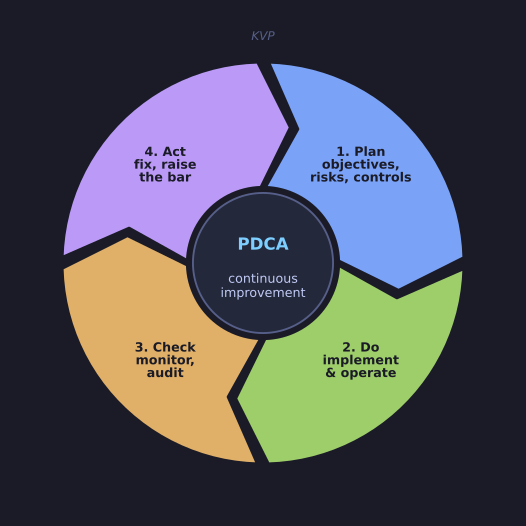
* PDCA as a closed feedback loop — Act feeds lessons back into Plan (KVP / continuous improvement). *
| Phase | What happens |
|---|---|
| Plan | Define objectives, identify risks, plan controls and processes |
| Do | Implement and operate the plan |
| Check | Monitor, measure, audit — compare to the plan |
| Act | Fix what didn't work, raise the bar, feed lessons back into Plan |
PDCA is the engine behind ISO 9001, ISO 14001, ISO 27001, BSI 200-1 and essentially every "Managementsystem nach ISO". Visualised as a spiral, each turn lifts the organisation to a higher level of maturity ("Quality Improvement over Time").
Where it came from:
- Originally Walter Shewhart in the 1930s as a statistical quality control loop.
- Popularised by W. Edwards Deming in post-war Japan, which is why it's sometimes called the Deming cycle.
Why this matters for security: "Sicherheit" is not a state you reach once — threats change, the organisation changes, and controls decay. Without an explicit feedback loop, a security programme drifts back into chaos within a couple of years.
Tip: ISO 27001:2022 dropped the explicit PDCA labels from the standard, but the structure (Plan ≈ clauses 4–6, Do ≈ 7–8, Check ≈ 9, Act ≈ 10) is still PDCA in disguise.
Go deeper:
- PDCA (Plan-Do-Check-Act) — origin (Shewhart), Deming's Japan work, and the continuous-improvement loop behind every ISO management system.

Note saved — thanks!