Question
Cryptology splits into two complementary disciplines — what are they, and what does each one do?
Answer
Cryptography builds the protection (encryption); cryptanalysis tries to break it (extracting information from ciphertext).
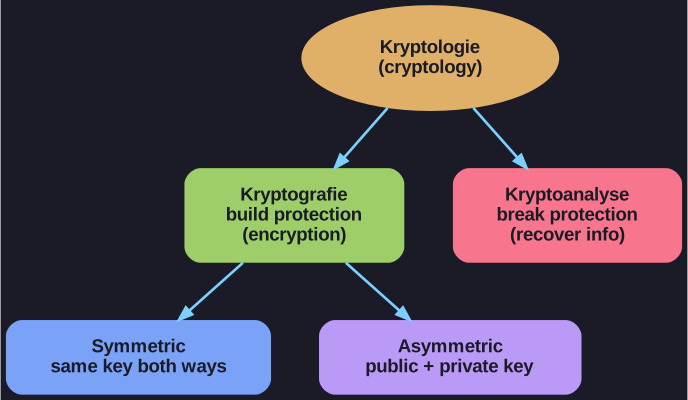
* Cryptology splits into building protection (cryptography) and breaking it (cryptanalysis); cryptography further splits into symmetric and asymmetric. *
Kryptologie (cryptology) is the umbrella term, divided into:
| Discipline | Goal |
|---|---|
| Kryptografie (cryptography) | Verschlüsselung — encrypting/protecting information |
| Kryptoanalyse (cryptanalysis) | Informationsgewinn — recovering information from encrypted data |
The two are in a permanent arms race: cryptographers design schemes, cryptanalysts attack them, and schemes that survive sustained cryptanalysis are the ones we trust.
Tip: "-grafie" = writing (building secrets), "-analyse" = breaking (taking them apart). Both together = cryptology.
Go deeper:
 Cryptanalysis (Wikipedia) — the "breaking" half of cryptology, from Enigma to modern side-channel attacks.

Note saved — thanks!
Question
What is the fundamental difference between symmetric and asymmetric cryptography?
Answer
Symmetric uses the same key to encrypt and decrypt; asymmetric uses different keys (a public/private pair).
| Symmetric | Asymmetric | |
|---|---|---|
| Keys | one shared secret key | a key pair: public + private |
| Encrypt / decrypt | same key for both | different keys for each |
| Also called | secret-key crypto | public-key crypto |
| Key challenge | distributing the shared secret safely | binding a public key to the right identity |
Why both exist: symmetric crypto (AES) is fast and great for bulk data, but needs a secure way to share the key. Asymmetric crypto solves key distribution but is slow. Real systems (like TLS) combine them: asymmetric to exchange a key, symmetric for the actual data.
Tip: Symmetric = one key both ways. Asymmetric = two keys, mathematically linked, that undo each other.
Go deeper:
- Symmetric-key algorithm (Wikipedia) — the same-key family (AES, ChaCha20) and its key-distribution problem.
- Public-key cryptography (Wikipedia) — how a key pair sidesteps that distribution problem.

Note saved — thanks!