Question
What is the difference between data, information, and knowledge (the DIKW idea)?
Answer
Data are raw symbols; information is data given meaning; knowledge is information linked into a wider understanding.
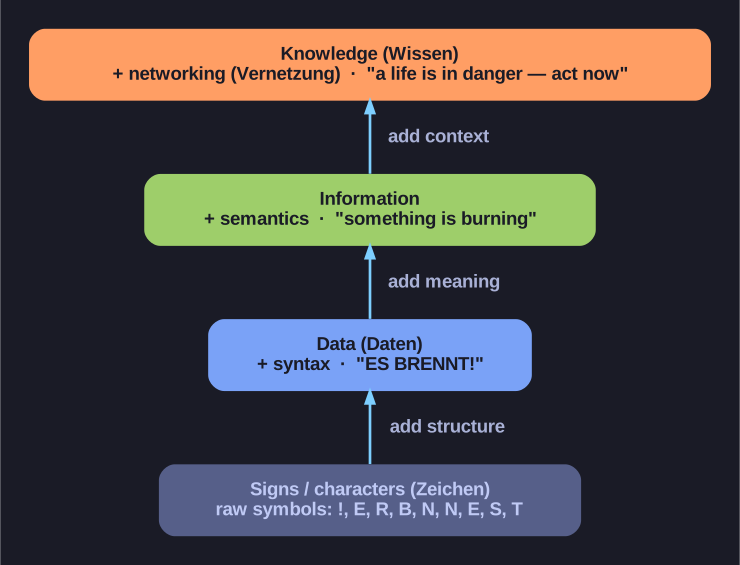
* The Z-D-I-W ladder: each rung adds syntax, then semantics, then context — turning raw symbols into actionable knowledge. *
It's a ladder where each rung adds something to the one below:
| Level | What it adds | Example |
|---|---|---|
| Signs/characters (Zeichen) | nothing yet — raw symbols | !, E, R, B, N, N, E, S, T |
| Data (Daten) | syntax (structure/order) | ES BRENNT! |
| Information | semantics (meaning) | "It is hot / something is burning" |
| Knowledge (Wissen) | context + networking with other info | "A life is in danger — act now" |
Why it matters for security: we don't really protect bits for their own sake — we protect them because, interpreted, they become information and knowledge that has value (and can be misused). This is also why information security is broader than IT security: the same information can live on a disk, on paper, or in someone's head.
Tip: Remember the chain Z-D-I-W: Zeichen → Daten → Information → Wissen = add syntax, then semantics, then Vernetzung (networking).
Go deeper:
 DIKW pyramid (Wikipedia) — the canonical data-information-knowledge-wisdom hierarchy this card is built on, with its history and critiques.
![A standard representation of the pyramid form of DIKW models, from 2007 and earlier[1][2]](https://upload.wikimedia.org/wikipedia/commons/thumb/0/06/DIKW_Pyramid.svg/960px-DIKW_Pyramid.svg.png)
Note saved — thanks!
Question
How big is a zettabyte, and where does it sit in the sequence of data-size units?
Answer
A zettabyte is 1000⁷ bytes (10²¹) — the scale humanity's total digital data now lives at.
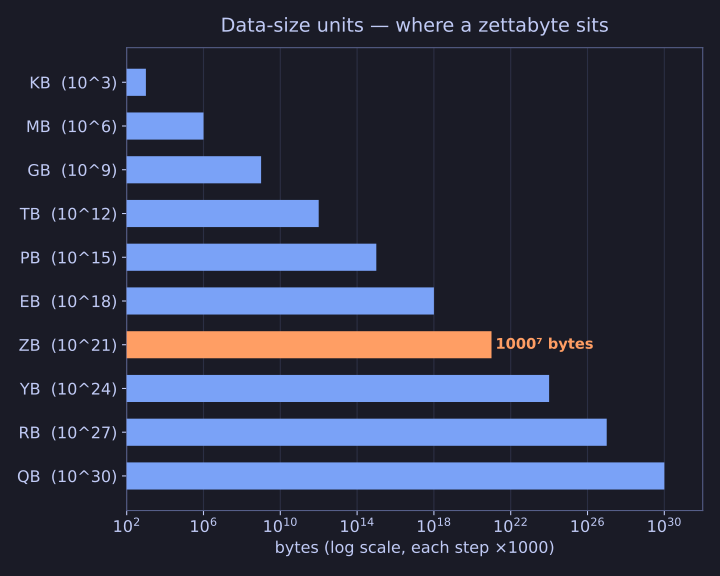
* Every step multiplies by 1000; a zettabyte (ZB) sits at 10^21 bytes — the seventh rung up from the byte. *
Each step up multiplies by 1000 (using the decimal SI convention):
Byte → KB → MB → GB → TB → PB → EB → ZB → YB → RB → QB
- Kilobyte (KB) = 1000¹
- Megabyte (MB) = 1000²
- Gigabyte (GB) = 1000³
- Terabyte (TB) = 1000⁴
- Petabyte (PB) = 1000⁵
- Exabyte (EB) = 1000⁶
- Zettabyte (ZB) = 1000⁷
- Yottabyte, Ronnabyte, Quettabyte = 1000⁸ ⁹ ¹⁰
Gotcha: marketing/SI units are powers of 1000; the binary units your OS often reports (KiB, MiB, GiB) are powers of 1024. A "1 TB" disk shows up as ~0.91 TiB for exactly this reason.
Go deeper:
- Zettabyte (Wikipedia) — defines the 10^21-byte unit and the decimal-vs-binary (ZiB) distinction behind the card's gotcha.
- SI metric prefixes (Wikipedia) — the official prefix table including ronna (10^27) and quetta (10^30), adopted in 2022.

Note saved — thanks!