Question
What kinds of trace evidence does a forensic institute compare to link a suspect to a crime scene, and what's the underlying principle?
Answer
Forensic comparison rests on Locard's exchange principle: every contact leaves a trace. Investigators photograph or cast a "Spur" (crime-scene trace), then compare it microscopically against a "Vergleichsspur" (reference trace) from a suspect's tool, shoe, tire, or weapon.
Common trace categories:
| Trace type | German | Source | What's compared |
|---|---|---|---|
| Shoe prints | Schuhspuren | Footwear | Sole pattern + individual wear marks (cuts, stones lodged in tread) |
| Tool marks | Werkzeugspuren | Crowbars, screwdrivers, bolt cutters | Striation pattern left by the tool's edge — unique like a fingerprint |
| Tire tracks | Reifenspuren | Vehicle tires | Tread pattern + wear damage |
| Lock marks | Schlossspuren | Picks, bump keys, drills | Scratches on pins and inside the keyway |
Two levels of identification:
- Class characteristics — the brand/model (e.g., "this was a Nike Pegasus, size 42") narrows the suspect pool.
- Individual characteristics — accidental marks acquired through use (a chip in the sole, a nick on the screwdriver tip). These are what uniquely identify a single object.
Why microscopes matter: A factory-fresh tool has only class characteristics — every tool of the same model looks identical. After use, random wear creates micro-features visible only at high magnification. The forensic match is built on those micro-features.
Tip: This is the same principle as ballistics matching (bullet striations) and fingerprint ridges — unique patterns acquired through wear or growth, then compared 1:1 under magnification.
Go deeper:
 Locard's exchange principle (Wikipedia) — the "every contact leaves a trace" principle underlying suspect-to-scene linkage.
- Trace evidence (Wikipedia) — the material types (fibers, glass, hair, residue) and how they associate suspect with scene.
Note saved — thanks!
Question
How old is the concept of a lock and key, and what was the Egyptian pin-tumbler ancestor of the modern lock?
Answer
Locks predate writing — the Egyptian Fallriegelschloss is dated to around 4000 years ago, and it already used the same pin-and-bolt principle that powers your front door today.
The Egyptian "drop-bolt" lock:
- A wooden bolt slides through staples in the door.
- Holes in the top of the bolt hold loose pins that drop down (gravity-driven) into matching holes in the housing → bolt is locked.
- The key is a wooden stick with prongs matching the pin pattern — insert it from below, push the pins up out of the bolt, and slide the bolt sideways.
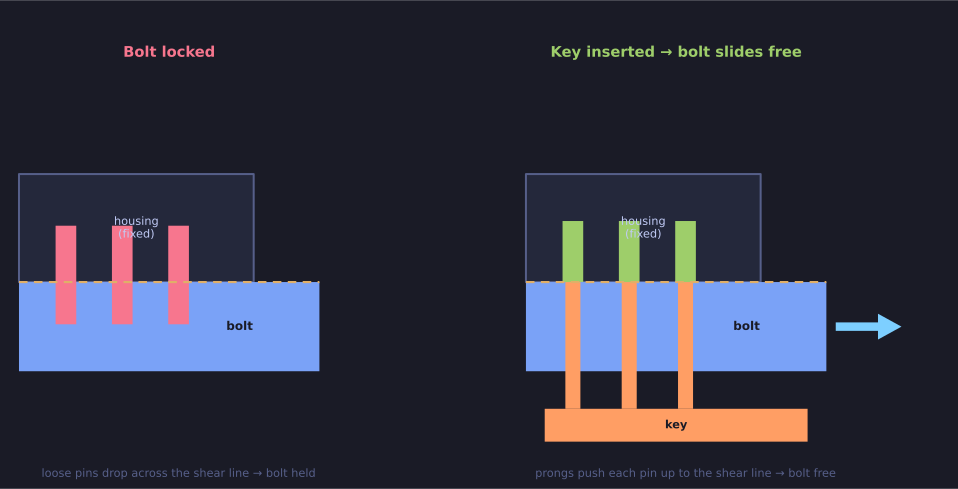
* Locked (pins dropped across the shear line) vs. key inserted (prongs lift the pins to the shear line, bolt slides free). *
Why this matters historically:
The Egyptian design contains the two essential ideas every modern pin-tumbler still uses:
- A shear line — a boundary that pins must clear for the bolt to move
- A coded key — the only object that lifts each pin to the right height
The oldest physical lock fragments archaeologists have recovered date to ~722 BC (Khorsabad, Assyria). The principle is older than the wheel-driven gears of medieval Europe.
Tip: When someone says "Yale invented the pin-tumbler in 1848," that's a half-truth — Yale invented the modern compact metal cylinder. The mechanism itself is 4 millennia old.
Go deeper:
- Lock (security device) — History — traces the line from the Egyptian wooden pin lock through Roman warded locks to Linus Yale's 1861 pin tumbler.
Note saved — thanks!