Question
What are the formal fallacies "denying the antecedent" and "affirming the consequent"?
Answer
Two invalid conditional forms: denying the antecedent (if A→B, not-A, ∴ not-B) and affirming the consequent (if A→B, B, ∴ A).
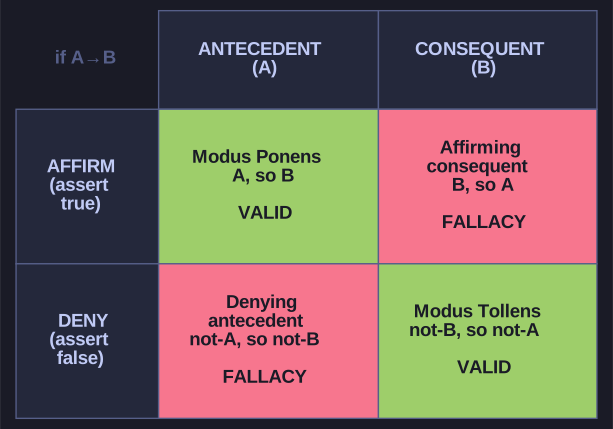
* Affirm the antecedent or deny the consequent = valid; affirm the consequent or deny the antecedent = fallacy. *
These look like the valid conditional forms but are formal fallacies — invalid argument structures:
- Denying the antecedent: (P1) If A, then B. (P2) Not-A. (K) Therefore not-B. — Invalid: A's absence doesn't rule out B, because B might be brought about some other way.
- Affirming the consequent: (P1) If A, then B. (P2) B. (K) Therefore A. — Invalid: B being true doesn't prove A, because something else could have made B true.
Example of affirming the consequent: "If it rained, the street is wet. The street is wet. Therefore it rained." — but a burst pipe could also explain the wet street.
Tip: Pair them with the valid forms: modus ponens (affirm A → get B) and modus tollens (deny B → get not-A) are valid; affirm B or deny A are the fallacies. Only the antecedent-affirming and consequent-denying directions are safe.
Go deeper:
 Affirming the consequent (Wikipedia) — why B being true does not establish A.
- Denying the antecedent (Wikipedia) — why not-A does not establish not-B.
Note saved — thanks!
Question
What two further dialogical dispositions round out the critical thinker's ethics, and what is the trap each addresses?
Answer
Staying focused (against deflection tactics) and guarding against arrogance/hubris (against the smugness that competence breeds).
- Staying focused — recognise and resist deflection: an opponent who derails the topic or deliberately deploys fallacies (e.g. the Red Herring, an irrelevant point introduced to distract). The countermeasure is to insist on clarity, pin down the main point, ask for the reasons, and demand relevance. This overlaps with the intellectual standards of good argument.
- Guarding against arrogance/hubris — the subtle danger of competence. Critical thinking enables "better" decisions and, ideally, better action — which makes it dangerously easy to become a know-it-all. The corrective is humility (Demut): don't be a smart-aleck.
The pairing matters because both failures come from skill, not lack of it: a skilled reasoner is exactly the person tempted to win by distraction or to lord their reasoning over others. Discipline plus humility is what keeps the skill in service of truth rather than ego.
Tip: Focus is aimed at the other side's tricks; humility is aimed at your own head. A good critical thinker watches both directions.
Note saved — thanks!