Question
Why is the word "best" put in quotation marks when people talk about finding the "best" solution to a problem?
Answer
Because there is no single absolute "best" — what counts as best depends on which criterion you optimise for, so "best" is always relative to a chosen yardstick.
The scare quotes are a warning against treating "best" as an objective property of a solution. A solution can be best on one axis and poor on another:
- Fastest is not the same as most durable.
- Cheapest is not the same as most valuable.
- Easiest to build is not the same as the one users gain most from.
So before declaring anything "best", you have to ask best for what, and for whom? Naming the criterion turns a vague argument ("this is obviously the best option") into a defensible one ("this is the best option given that we value speed over polish here").
Tip: Whenever someone insists a solution is simply "the best", ask "by which measure?" — the quotation marks are doing exactly that work.
Go deeper:
 Wikipedia — Trade-off — why gaining on one quality usually costs you another, so "best" is always relative.
Note saved — thanks!
Question
Along which dimensions can two candidate solutions each be called "best", and what single trade-off do they all reduce to?
Answer
Different solutions win on different axes — time, money, feasibility, reputation, user value — but every axis ultimately collapses into "effort versus return" (Aufwand und Ertrag).
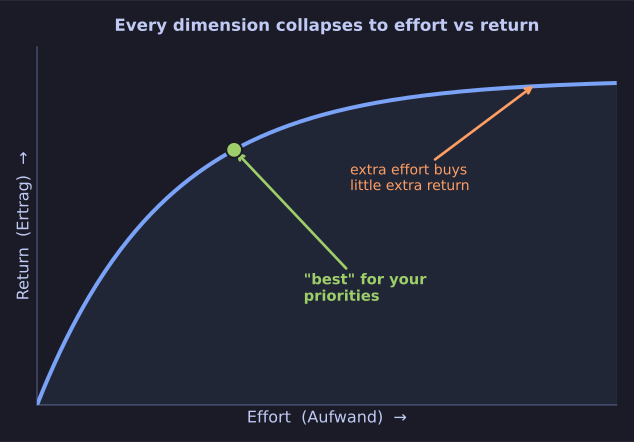
* All the "best" axes reduce to one curve: past the sweet spot, extra effort buys little extra return. *
The same problem yields several "best" solutions depending on what you weight:
| Dimension | The tension |
|---|---|
| Time (zeitlich) | Fast vs sustainable/durable |
| Money (finanziell) | Cheap vs valuable |
| Feasibility (Machbarkeit) | Easy vs effortful to build |
| Reputation (Ansehen) | Relevant vs irrelevant to standing |
| User value (Mehrwert) | Something users must do vs something they get to do |
These are not independent: spend more (money, effort, time) and you usually get more durability or value, and vice versa. That is why they all reduce to one balance — effort versus return. "Best" is just the point on that curve where the return justifies the effort for your particular priorities.
Go deeper:
- Wikipedia — Diminishing returns — the maths behind "more effort eventually stops paying off."
Note saved — thanks!