Question
What are the four things that critical thinking presupposes or rests on, according to its core thesis?
Answer
Critical thinking is reasoning that (1) requires certain cognitive abilities, (2) springs from epistemic attitudes/virtues, (3) obeys intellectual standards of argument, and (4) respects ethical/dialogical norms.
The core thesis ("Grundthese") packs four distinct foundations into one definition — and they map onto four different failure modes if any is missing:
- Cognitive abilities ("faculty-traits") — the raw mental skills: analysing, inferring, distinguishing claims from reasons. Without them you literally can't do the work.
- Epistemic attitudes/virtues — dispositions like curiosity, intellectual honesty and humility. Skill without the disposition to use it well gets you a clever sophist, not a critical thinker.
- Intellectual standards of argument — the rules of logic and good reasoning that act as "quality assurance" for thinking. They keep the thinking valid, not merely fluent.
- Ethical/dialogical norms — fairness, respect, honesty towards others in dialogue. Reasoning happens with people, so how you treat their views is part of doing it well.
The word epistemic (from ancient Greek epistēmē = knowledge, cognition) means "concerning knowledge and its conditions" — the questions of how knowledge comes about, and what counts as certainty and justification.
Tip: Read the four as ability → character → logic → ethics. A critical thinker needs all four; drop any one and the reasoning breaks in a predictable way.
Go deeper:
 Critical thinking — Stanford Encyclopedia of Philosophy — a rigorous survey of the abilities, dispositions and standards the thesis names.
- Critical thinking — Wikipedia — overview linking the cognitive skills to the epistemic virtues.
Note saved — thanks!
Question
What are the parts of the Toulmin model of argument, and what question does each answer?
Answer
Data → Conclusion, licensed by a Warrant, which is itself propped up by Backing — with an optional Rebuttal that flags exceptions.
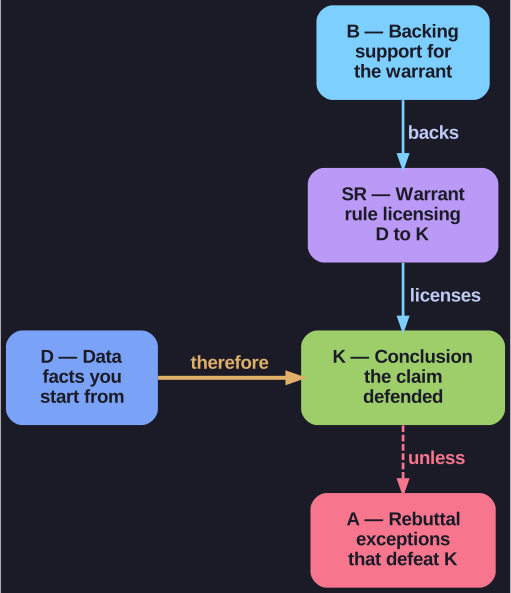
* The Toulmin model: Data leads to a Conclusion, licensed by a Warrant that Backing supports; a Rebuttal marks the exceptions. *
The Toulmin schema (Stephen Toulmin) is a map of how a real argument hangs together — richer than "premises → conclusion" because it exposes the often-hidden rule that connects them:
| Part (German) | Role | The question it answers |
|---|---|---|
| D — Data (Daten) | The facts/evidence you start from | "How do you get to that?" |
| K — Conclusion (Konklusion) | The claim you're defending | (the thing being argued for) |
| SR — Warrant (Schlussregel, Prinzip) | The general rule licensing D → K | "How do you get across to it?" |
| B — Backing (Begründung, Stützung) | Support for the warrant itself | "Why should that rule hold?" |
| A — Rebuttal (Ausnahmebedingung) | Conditions under which K does not follow | (the exception that defeats it) |
The point of the model: an argument isn't just data and a conclusion. There's always a warrant — a bridging rule — and that warrant usually needs its own backing. Making the warrant explicit is where most disagreements actually live.
Tip: D and K are the visible parts; SR is the bridge between them and B is what holds the bridge up. The Rebuttal (A) is what stops a warrant from being treated as absolute.
Go deeper:
- Stephen Toulmin & the Toulmin model — Wikipedia — the six components of his argument model and where it came from.
Note saved — thanks!