Question
What does "critical thinking" actually mean, and what is its goal?
Answer
Thinking for yourself instead of accepting claims at face value — withholding snap judgements, weighing alternatives and asking "why?" — so that you handle and pass on knowledge responsibly.
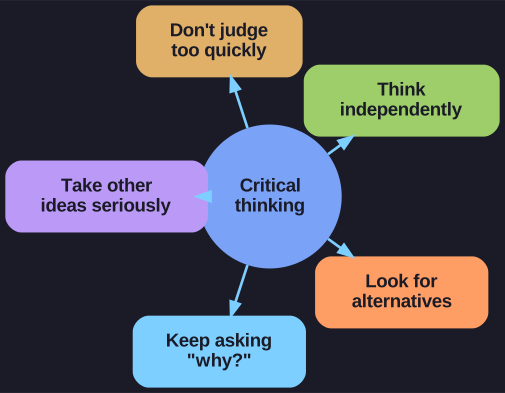
* The five recurring moves that make up a critical-thinking stance. *
Critical thinking is not being negative or sceptical of everything. It is a disciplined habit of reasoning made of a few moves:
- Think independently — form your own judgement rather than adopting one ready-made.
- Avoid judging too quickly — resist the first plausible conclusion; let evidence catch up.
- Accept that different ideas exist — take opposing views seriously enough to evaluate them.
- Keep asking "why?" — push past the surface claim to its reasons.
- Look for alternatives — assume there may be another explanation or solution you haven't seen.
The point of all this is practical, not academic: a responsible relationship with opinions, with the knowledge you pass on to others, and ultimately with how you act. Sloppy thinking spreads — so thinking well is partly an ethical duty, not just a skill.
Tip: A useful one-line test — "Could I explain why I believe this to someone who disagrees?" If not, you've recognised a claim, not thought critically about it.
Go deeper:
 Wikipedia — Critical thinking — the concept's history (from Socrates on) and its place in education and the professions.
Note saved — thanks!
Question
What are the three working steps of a critical-thinking process when you face a problem?
Answer
Define the problem → research it from diverse, vetted sources → check yourself for bias before concluding.
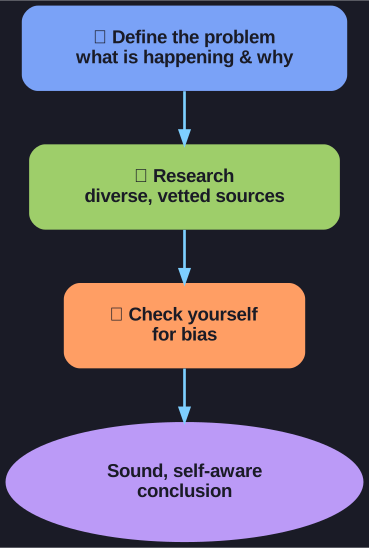
* Frame the problem, research it widely, then audit your own bias before concluding. *
- Define the problem. Ask what is actually happening, why the situation is the way it is, what your initial hypothesis is, and what the possible solutions might be. You can't think clearly about a problem you haven't stated clearly.
- Research — but beware bubbles. Deliberately gather different sources rather than ones that already agree with you (filter/echo "bubbles" feed you confirmation, not truth), and judge each source's relevance: how reliable is it, how old is it, how much does it really tell you?
- Stay unbiased. Before you settle, interrogate yourself: Do I already have assumptions? Have I overlooked something? Have I considered all the perspectives?
The order matters: jumping straight to "solutions" without framing the problem or checking your own bias is exactly how confident-but-wrong conclusions happen.
Go deeper:
- Wikipedia — Confirmation bias — the pull that makes step 2 (diverse sources) and step 3 (self-check) so necessary: we favour evidence that fits what we already think.
Note saved — thanks!