Question
Which methods does the BinaryTree ADT add to the Tree ADT?
Answer
It inherits every Tree ADT method and adds left(p), right(p) and sibling(p).
A binary tree is still a tree, so root, parent, children, isInternal, isExternal and the rest all remain available. The three additions exist because the left/right distinction is the defining feature of a binary tree:
left(p)— the left child ofp(or nothing if it has none)right(p)— the right child ofpsibling(p)— the other child ofp's parent
children(p) alone would lose information here: it returns the children as a list, and a list with one element cannot say whether that element is the left or the right child.
sibling(p) is a convenience: it is the parent's other child, which algorithms often need (for example, when restructuring a tree after a deletion).
Note saved — thanks!
Question
How do you insert a node at the head of a singly-linked list, and why does the order of the steps matter?
Answer
First point the new node at the old head (v.next ← head), then move head to the new node (head ← v), then increment size — $O(1)$.
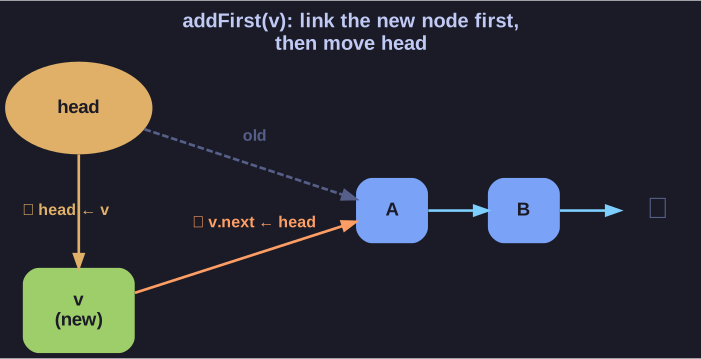
* Step ① keeps the old list reachable through v before step ② moves head away from it. *
Algorithm addFirst(v)
  v.setNext(head)     { new node points to the old first node }
  head ← v            { head now points to the new node }
  size ← size + 1
Why the order matters: head is the only reference to the existing chain. If you did head ← v first, the old first node would no longer be referenced by anything, and v.setNext(head) would then make v point to itself. The rest of the list would be lost. Linking the new node before moving the entry point is the general rule for pointer surgery: never overwrite a reference until something else holds on to what it pointed to.
The operation touches a constant number of references regardless of the list length, so it runs in $O(1)$. It also works on an empty list: head is null, so v.next becomes null and v is the only node.
Note saved — thanks!