Why does a typical IoT deployment use two different radio technologies rather than one?
Separating endpoint radio links from backhaul lets a gateway carry the cost of Internet connectivity; direct low-power cellular is an alternative for suitable workloads.
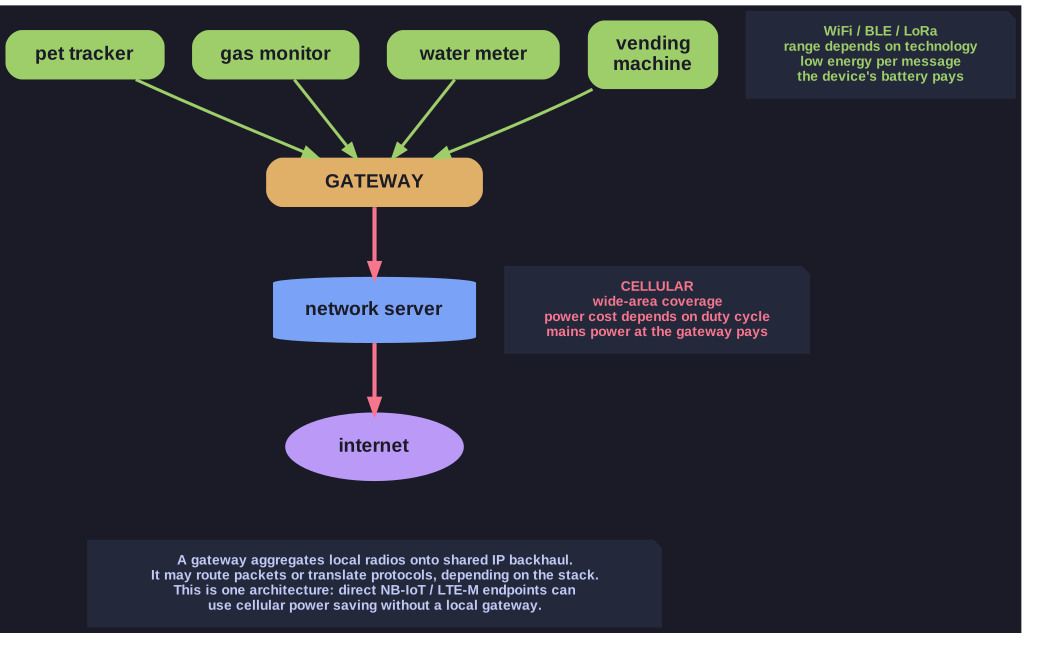
* A gateway can bridge endpoint radio links to cellular backhaul; direct cellular endpoints are another option when their power budget permits. *
The standard picture has endpoints — a pet tracker, a gas monitor, a water meter, a vending machine — connecting over WiFi, BLE or LoRa to a nearby gateway, with the gateway connecting over cellular to a network server and on to the internet.
The split exists because radio range and energy cost pull against each other:
| Device → gateway (WiFi / BLE / LoRa) | Gateway → internet (cellular) | |
|---|---|---|
| Range | Metres to a few kilometres | Wide-area, wherever there is coverage |
| Energy per message | Low enough for a battery to last months or years | Depends on modem, coverage, peak current and duty cycle |
| Infrastructure needed | A gateway within range | A mobile network subscription |
| Who pays the power bill | The device's battery | Usually mains power at the gateway |
So the gateway is doing two jobs at once: it is a protocol translator between a constrained link and the internet, and it is an energy broker, spending mains power so the endpoints do not have to spend battery. LoRa complicates the neat picture slightly — it reaches kilometres at very low power, but at very low data rates, which is exactly the trade that makes it usable for a water meter and useless for a camera.
Tip: when you see a device claiming direct cellular and multi-year battery life, check the duty cycle. It is almost certainly transmitting very rarely — the physics has not changed, the schedule has.
Go deeper:
 Wikipedia — LPWAN — the long-range low-power side of the trade in detail, with LoRaWAN, NB-IoT and Sigfox and the 0.3–50 kbit/s ceiling that comes with them.