Quiz Entry - updated: 2026.10.15
Which HTTP methods and data formats does RESTCONF support, and what does a RESTCONF request look like?
RESTCONF supports GET, POST, PUT, DELETE and OPTIONS (the RFC also defines PATCH and HEAD), with request and response bodies in JSON or XML. A request is an HTTPS call to a URL that follows the YANG path.
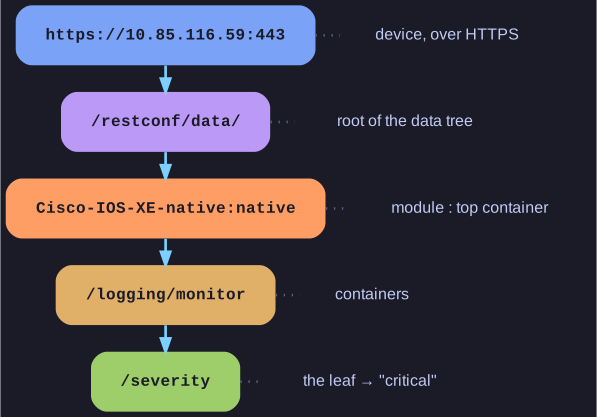
* Each URL segment walks one step down the YANG tree, ending at the leaf that holds the value. *
Reading a router's logging severity:
GET https://10.85.116.59:443/restconf/data/Cisco-IOS-XE-native:native/logging/monitor/severity
Accept: application/yang-data+json

200
{
  "Cisco-IOS-XE-native:severity": "critical"
}
How to read it:
/restconf/data/is the root of the data tree.Cisco-IOS-XE-native:native/logging/monitor/severityis the path through the YANG model (module:container/…/leaf).Accept: application/yang-data+jsonasks for JSON. With…+xmlyou would get XML instead.200means the request succeeded, and the body holds exactly the one leaf requested.
Writing works the same way. A PUT or PATCH to that URL with a JSON body changes the value, and DELETE removes it.