What scale of IoT deployment do the industry figures project, and why does that scale matter for security rather than just for business plans?
Historical industry figures of roughly 11.2 billion connected things for 2018 and projections in the tens of billions by 2030 — a population so large that anything insecure becomes a weapon at internet scale.
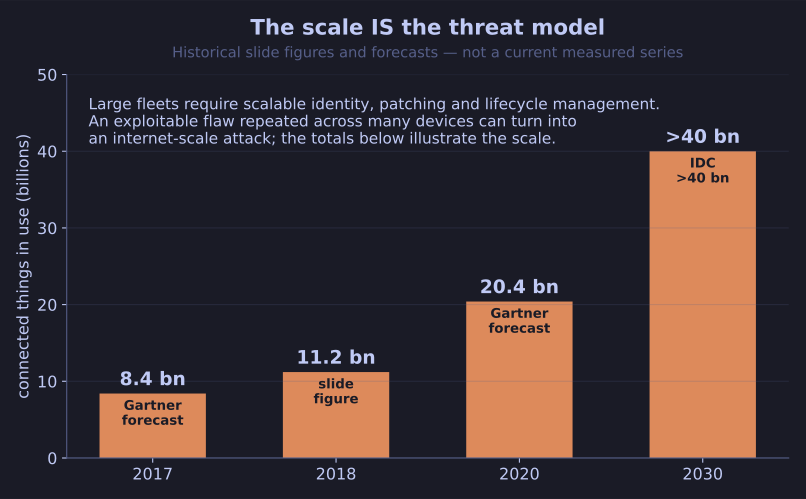
* Historical industry figures and dated projections illustrate scale; forecasts are not measured outcomes. *
The figures usually quoted for the growth curve:
| Figure | Source and year |
|---|---|
| 8.4 billion connected things projected for use (up 31% on 2016) | Gartner, 2017 |
| 11.2 billion connected things projected | 2018 |
| 20.4 billion connected things by 2020 | Gartner projection |
| Over 40 billion connected things by 2030 | IDC projection |
| $283 billion invested in the IoT ecosystem across Europe, the Middle East and Africa by 2028 | IDC projection |
| $261 billion global edge-computing spend in 2025, reaching $380 billion by 2028 | IDC projection |
Two consequences follow, and the second is the one that matters here:
- Commercially, the challenge is meeting explosive demand — the market grows faster than the engineering practice behind it, which is precisely how insecure products reach the field.
- For security, the number is the threat model. Millions of enterprise IT devices are managed by someone; tens of billions of IoT devices largely are not. A vulnerability that affects a 0.1% slice of a 40-billion population is still forty million compromised hosts — which is the arithmetic behind every large IoT botnet.
Tip: treat the exact projections as illustrative, not gospel — forecasts from 2017 for 2020 were optimistic. The order of magnitude is the load-bearing part: billions, not millions.
Go deeper:
 Wikipedia — Internet of things — carries current connected-device counts, which is a useful reality check against the older projections quoted above.