Quiz Entry - updated: 2026.08.02
What is the key scaling problem with symmetric cryptography?
With $n$ participants, you need $\frac{n(n-1)}{2}$ keys — the number of keys grows quadratically.
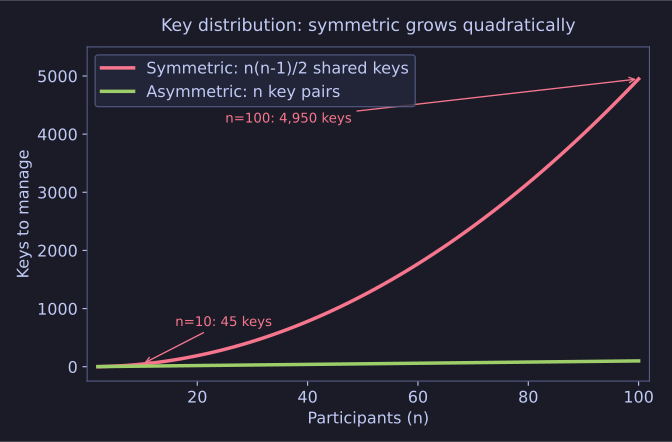
* Symmetric keys grow as n(n-1)/2; asymmetric needs only n key pairs. *
In symmetric cryptography, every pair of communicating parties needs a unique shared secret key. The formula is:
$$\text{Keys} = \frac{n(n-1)}{2}$$
| Participants | Keys needed |
|---|---|
| 2 | 1 |
| 10 | 45 |
| 100 | 4,950 |
| 1,000 | 499,500 |
The biggest challenge isn't just the number — it's key distribution: how do you securely share a secret key with someone you've never met?
Asymmetric cryptography fixes this — each person only needs one key pair (public + private), so n participants need only n key pairs. The trade-off: asymmetric operations are significantly slower.
Go deeper:
 Secret Key Exchange (Diffie-Hellman) - Computerphile - how the key-distribution problem is solved without a courier.
 Key distribution - the core problem of pre-sharing symmetric secrets, and why it explodes with more parties.