What is the core principle behind public-key (asymmetric) cryptography?
Encryption is an "easy" mathematical function whose inverse (decryption without the secret) is presumed to be hard. Anyone can encrypt with the public key; only the holder of the private key can decrypt.
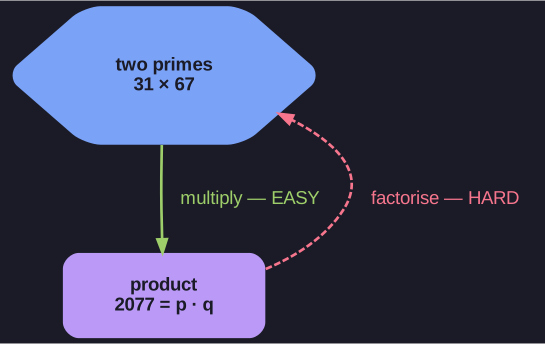
* The trapdoor at the heart of public-key crypto: multiplying 31×67 is trivial; factoring 2077 back into its primes is hard. *
The textbook analogy is multiplication vs. factorisation:
| Direction | Example | Difficulty |
|---|---|---|
| Multiplication | 31 × 67 = 2077 |
Trivial — seconds with pen and paper |
| Factorisation | 2077 = ? × ? |
Hard — for huge numbers, computationally infeasible |
This one-way / trapdoor function is the foundation of every PK scheme. Encryption uses the public-key transformation; decryption needs the private "trapdoor" that makes the inverse easy.
Important caveats:
- "Hard" means we don't know an efficient algorithm. None of these are proven hard — RSA's security depends on factoring being hard, but mathematicians haven't ruled out a fast factoring algorithm. A working quantum computer running Shor's algorithm would break RSA in polynomial time.
- The scheme is asymmetric because the encrypt direction is easy for everyone, but decrypt is easy only with the private key.
Tip: The whole asymmetric crypto field hinges on "P ≠ NP and these specific problems are hard." If P = NP turned out true, factoring (and RSA) would fall — and the Clay $1M prize, plus a lot of internet security, would be the casualty.
Go deeper:
 Trapdoor function (Wikipedia) — easy one way, hard to invert without the secret trapdoor.