What is the "a question of timing" principle (Beobachten – Anmerken), and how does the KVP analogy explain it?
Observe in the moment, raise it at the right later moment — improvement comes from feeding observations into a review afterwards, not from interrupting the action.
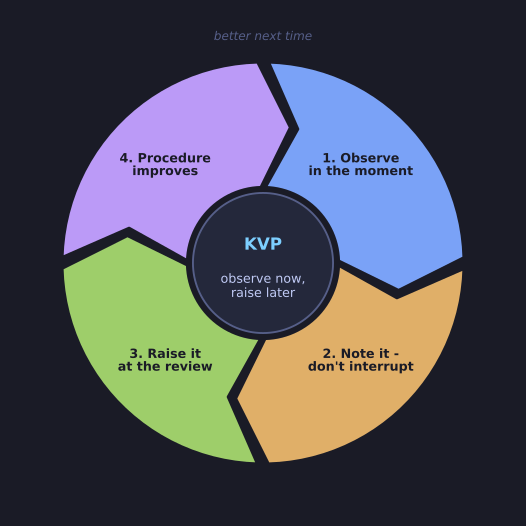
* An observation isn't lost — it feeds a continuous-improvement (KVP) loop where, at the right moment, it can actually change the procedure. *
In a high-stakes operation the skill isn't whether to question but when:
- Beobachten – Anmerken = "observe – remark/note". You notice something during the action but voice it at the appropriate time, which may be later.
- KVP (Kontinuierlicher Verbesserungsprozess, continuous improvement process) is the industrial analogy: front-line workers don't stop the line to argue, they capture observations that feed a structured improvement cycle.
The lesson transfers directly: an observation made during a crisis is valuable, but its right channel is usually the debrief or review, where it can actually change the procedure — not the acute moment, where it only adds noise and delay.
Tip: This reframes "I wasn't allowed to ask" — you were allowed to think and observe; the constraint was only on when to surface it.
Go deeper:
 Wikipedia — Continual improvement process — KVP/Kaizen: feeding front-line observations into a structured improvement loop.
- Wikipedia — PDCA — the Plan-Do-Check-Act cycle that formalises "observe now, improve later".