What is multi-hop relaying in LTE, and what two problems does it solve?
Relay stations (RS) extend the network by receiving and re-transmitting signals: they raise transmission rates for users in shadowed areas or at the cell boundary, and they extend coverage without laying new fiber.
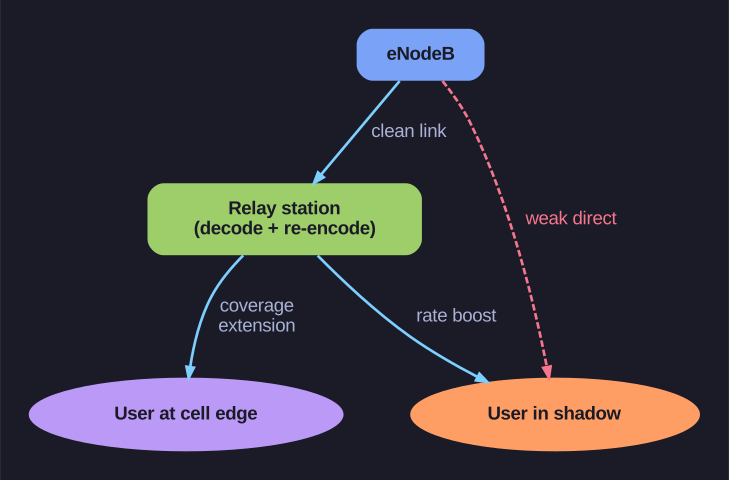
* A relay decodes and re-encodes: it turns the eNodeB's clean link into a strong local signal — a rate boost for a shadowed user and coverage extension at the edge, where the direct path (dashed) is weak. *
The two use cases:
-
Rate enhancement in shadowed areas: A user behind a building or hill receives a weak, slow signal directly from the base station. A relay station placed with good visibility to both can receive the signal cleanly and re-transmit it locally → the shadowed user gets a strong signal and a high rate.
-
Coverage extension: Deploying relay stations at the cell border stretches the network's reach — without needing a full base station with its own fiber backhaul, because the relay connects to the network over the air.
Bonus effect: Relays enable more aggressive radio resource reuse — the same frequencies can be reused at lower power in more places.
Relay vs. small cell: Both shrink the distance to the user. The difference is the backhaul: a small cell needs a wired (or dedicated) connection to the core, while a relay uses the same radio network it serves — cheaper to deploy, but it consumes radio resources for its own backhaul.
Tip: Think of a relay as a "signal repeater with intelligence" — it doesn't just amplify (which would amplify noise too), it decodes and cleanly re-encodes the signal.
Go deeper:
 Relay network (Wikipedia) — the source → intermediate node → destination principle LTE relays apply for shadow-area rate and coverage.
- Heterogeneous network (Wikipedia) — how relays and small cells densify a macro network (HetNet/SON).