What did an MIT study find when people wrote essays with an AI chatbot instead of unaided, and why does it matter for learning?
Their brains were markedly less engaged — up to about 55% lower cross-region connectivity — and afterwards they could barely recall or claim their own essays: the AI did the thinking, so little got learned.
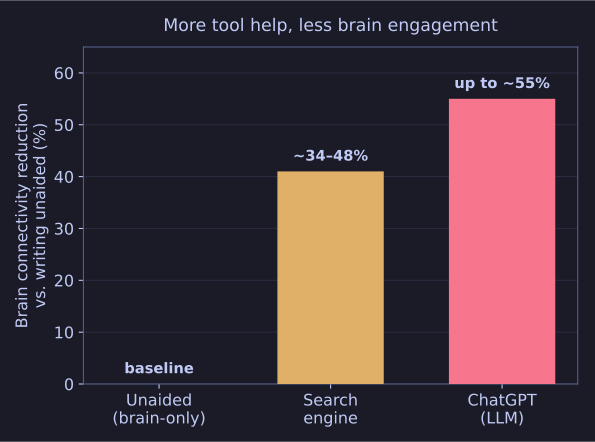
* EEG connectivity dropped further the more the tool did the work — most of all in the ChatGPT group. *
A 2025 MIT Media Lab study (led by Nataliya Kosmyna; a preprint that is not yet peer-reviewed, so treat it as preliminary) had Boston-area students write essays over several sessions in three conditions: unaided ("brain-only"), search-engine, and ChatGPT (GPT-4o). An EEG (electroencephalogram — electrodes that read the brain's electrical activity) tracked how much different brain regions were exchanging information.
- The AI group's brain connectivity was the lowest of the three — up to a ~55% drop versus writing unaided, with the search-engine group in between. Less cross-talk means less of the executive-function, attention and semantic-processing work that lays down memory.
- Afterwards the AI group could barely quote or feel ownership of "their" essays — weaker recall than the unaided writers.
- Asked later to write without the tool, the former AI users did worse — the skill hadn't transferred.
This is the empirical version of the "laying tracks" idea: offload the effort to the chatbot and the trace that turns doing into learning never gets laid. The researchers named the resulting pile-up of un-learned shortcuts "cognitive debt."
Tip: The lesson isn't "never use AI" — it's that whoever does the cognitive work is the one who learns. Let the tool draft for you and your brain sits out; make it question and coach you instead, and you stay in the loop.
Go deeper:
 The Register — "Brain activity much lower when using AI chatbots, MIT boffins find" — a readable write-up of the EEG and recall results.
- Kosmyna et al. — "Your Brain on ChatGPT" (MIT Media Lab, 2025) — the original preprint, with the group design and dDTF connectivity figures.