What are the five stages of an observability maturity model?
Initial → Monitoring → Observability → Proactive → Optimized: reactive firefighting, then defined metrics, then root-cause analysis across the three pillars, then early detection of anomalies, then data-driven automation.
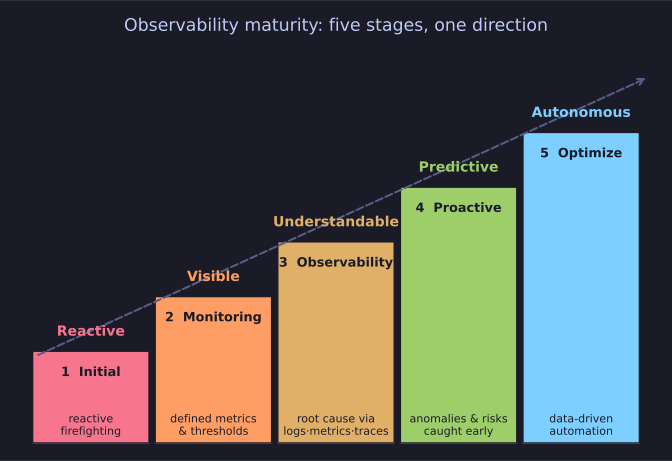
* Five stages, each with a capability word: what you can know about your system changes at every step. *
| Stage | Name | Focus |
|---|---|---|
| 1 | Initial | Reactive troubleshooting |
| 2 | Monitoring | Watching defined metrics |
| 3 | Observability | Root-cause analysis across logs, metrics and traces |
| 4 | Proactive | Detecting anomalies and risks early |
| 5 | Optimize | Data-driven optimisation and automation |
The same progression stated as capabilities: Reactive → Visible → Understandable → Predictive → Autonomous. That phrasing is the more useful one, because each word names what changed about the knowledge available, not about the tooling:
- Reactive: you learn about problems from users.
- Visible: you can see the state of your systems.
- Understandable: you can explain the state you see.
- Predictive: you can anticipate states you have not reached yet.
- Autonomous: the system responds to them without you.
Stages cannot be skipped in practice: tracing without reliable metrics leaves you with no baseline to compare against, and automated remediation built on data you do not trust simply automates your mistakes.
Go deeper:
 Capability Maturity Model — Wikipedia — the original five-level maturity idea that every later maturity model borrows from.