Walk through the four steps by which a sensor reading gets from an IoT device to a user's phone.
Gateway wakes the devices → devices hand over their sensor data → gateway forwards it over the internet to cloud servers → service apps visualise or notify the user on mobile devices.
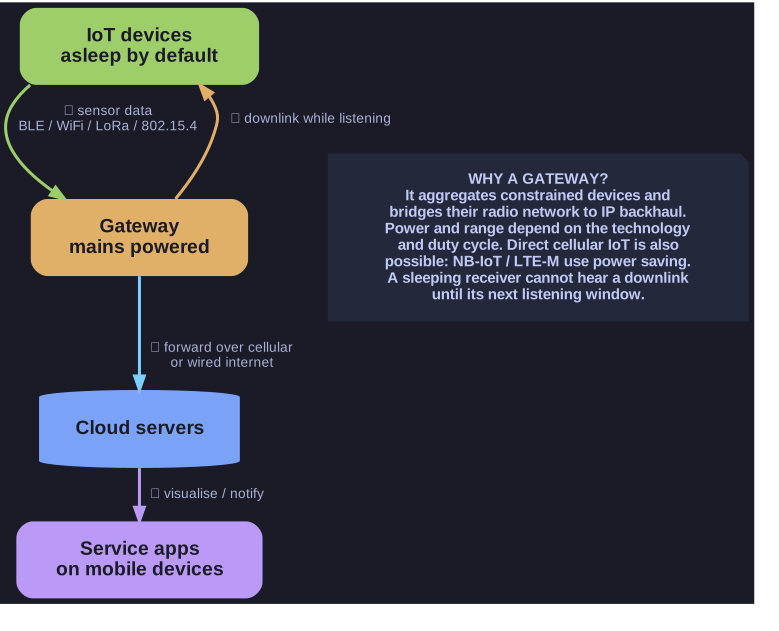
* In this gateway-mediated design, wake-up control travels towards the device and readings travel towards the user. *
The canonical end-to-end flow has four numbered steps:
- The gateway sends messages to wake up the devices. The devices are asleep by default — that is how they last on a battery — so the gateway, which usually has mains power, initiates.
- The gateway collects the sensor data from the devices. Over a short-range, low-power link: Bluetooth Low Energy, WiFi, LoRa, IEEE 802.15.4.
- The gateway transfers the collected data to the cloud servers. Over a fatter, more expensive link — cellular or wired internet — which the constrained devices themselves could not afford to run.
- Service apps visualise the results or notify the user on mobile devices.
The gateway is the interesting part of the story. It exists because the two links have completely different economics: a local link can minimise endpoint energy while a gateway handles the Internet connection. This is one architecture, not a physical necessity: low-duty-cycle cellular IoT devices can also achieve long battery life. The gateway is the impedance match between them — and consequently a concentration point for both traffic and risk, since it sees every device's data in one place.
On the cloud side, the platform is rarely built from scratch. Cloud services can provide device registries, ingestion, storage and analytics; the exact offerings and their support lifetimes need checking before choosing a platform.
Tip: the numbering is worth remembering in the right direction — the gateway initiates, not the device. A low-power wake-up receiver or scheduled listening lets the main radio sleep; other designs let the endpoint wake on its own timer and initiate transmission.
Go deeper:
 Wikipedia — Zigbee — a real product family built on exactly this pattern: low-power mesh devices sitting behind a bridge that is the only thing reaching the internet.