In an edge-computing IoT system, which functional blocks sit inside the smart device, and what does each one do?
Sensors, compute, storage, energy conversion and storage, energy management, and an RF transceiver — six blocks, two of which exist purely to manage power.
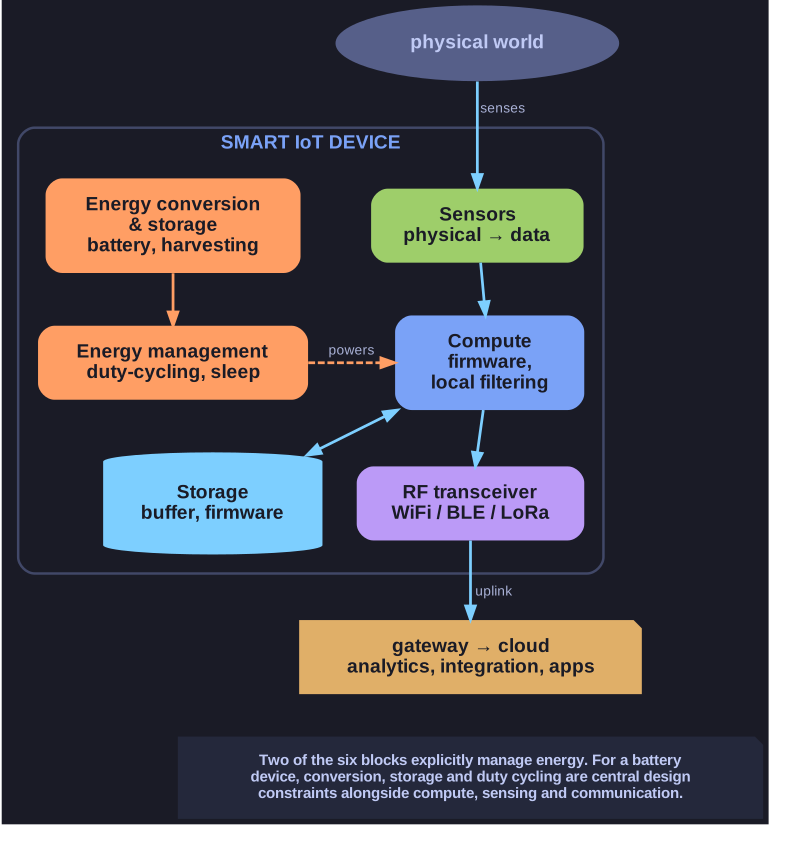
* Sensing, compute, storage and radio share a power budget managed by the two energy blocks. *
Sitting between the physical world and the cloud, the device carries:
| Block | Job |
|---|---|
| Sensors | Convert physical quantities into sensor data — the system's only contact with reality |
| Compute | Run the firmware, do local processing and filtering before anything is transmitted |
| Storage | Buffer readings when the link is down; hold firmware images and configuration |
| Energy conversion & storage | Harvest and store energy (battery, and where available solar/thermal/vibration harvesting) |
| Energy management | Duty-cycling, sleep states, deciding what runs when — the block that turns a fixed budget into years of life |
| RF transceiver | The radio: WiFi, cellular, BLE, LoRa — the link out |
What is worth noticing is the shape of the list: a third of the device exists only to feed the other two thirds. In a server you would never draw "energy management" as a peer of compute and storage; in a constrained device it is the block that determines whether the product works at all.
Beyond the device, the pipeline continues over WiFi or cellular, across the internet, to a cloud that does data analytics and visualisation, application integration and big-data processing, and finally out to service apps on mobile devices.
Tip: the two energy blocks are the tell. If a block diagram of an "IoT device" shows only sensors, compute, storage and radio, it is a diagram of a computer, not of an endpoint that has to survive unattended.
Go deeper:
 Wikipedia — Sensor node — the same block list in detail, with real numbers for the power source (0.5–2 Ah at 1.2–3.7 V) and the power-management techniques used to stretch it.
- Wikipedia — Energy harvesting — how solar, thermal, vibration and RF harvesting top up that budget, and how little each actually yields.