In a crisis setting like an operating theatre or a military operation, why is decision authority concentrated in one person at the top of a steep hierarchy, instead of shared democratically among the team?
Because divided labour needs coordination, rules and leadership — and tying the decision to whoever carries the liability (Haftpflicht) is what keeps action fast and coherent when there's no time to negotiate.
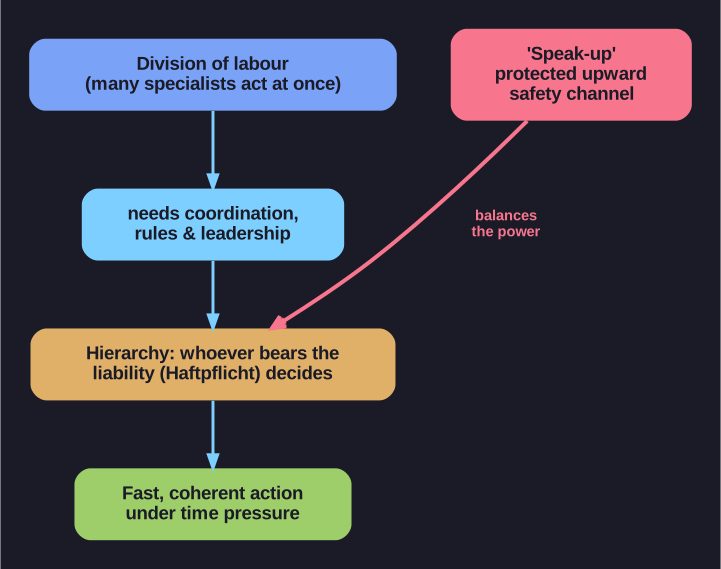
* Steep hierarchy isn't authoritarianism for its own sake — it's the mechanism that lets many specialists act as one, balanced by a protected Speak-up channel. *
The reasoning runs in a chain:
- Division of labour (Arbeitsteilung) — many specialists acting at once — only produces coherent action with coordination, rules and leadership. Without a single directing authority, parallel actions collide.
- Hierarchy answers who decides by tying it to responsibility: the person who bears the liability (Haftpflicht) is the one empowered to decide. This is also why clear, short orders are liability-relevant — the accountable person must be able to direct without negotiation.
- Under time pressure a democratic vote is a luxury the situation can't afford; concentrating the decision is what buys speed and unity of action.
The catch is that concentrated authority can also bury a safety concern — so it's deliberately balanced by Speak-up (a protected upward channel) and by the before/after review phases where the decision itself can be questioned. Authority for speed, Speak-up for safety.
Tip: "Whoever carries the responsibility decides" is the crisp version — it explains both why the surgeon barks orders and why a brigade commander's word is final: accountability and decision authority are deliberately fused.
Go deeper:
 Wikipedia — Unity of command — the principle that each team answers to a single commander so action stays coherent.
- Wikipedia — Division of labour — why splitting work among specialists demands coordination and leadership.