Quiz Entry - updated: 2026.07.30
How does challenge-response with a digital signature work for login?
Bob sends a random challenge in the clear. Alice signs it with her private key. Bob verifies the signature using her public key.
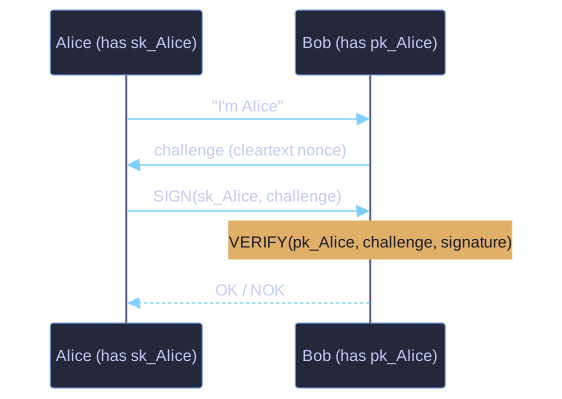
* Alice signs the challenge with her private key; Bob verifies with her public key — the modern default. *
Setup: Alice has sk_Alice; Bob has pk_Alice.
Login:
- Alice → Bob:
"I'm Alice". - Bob → Alice: random
challenge(cleartext nonce). - Alice → Bob:
signature = SIGN(sk_Alice, challenge). - Bob:
VERIFY(pk_Alice, challenge, signature)→ OK / NOK.
Why this is the modern preferred variant:
- Server doesn't have to do any encryption — just signature verification (cheap).
- The challenge is in the clear, so any eavesdropper sees it but can't produce a valid signature.
- Same as the encryption variant: server compromise doesn't leak Alice's secret.
This is the heart of:
- SSH public-key auth — server sends challenge, client signs with private key.
- WebAuthn / FIDO2 / passkeys — browser holds the key, signs server's challenge, and binds the signature to the origin so phishing fails.
- TLS client certificates — client signs the handshake transcript.
Tip: The fundamental phishing-resistance of WebAuthn comes from this scheme plus origin-binding — the signature includes the origin's domain, so a signature made for paypaI.com won't be accepted by paypal.com.
Go deeper:
 Digital signature — Wikipedia — signing with the private key, verifying with the public key, and why it proves origin.