What are the four core activities of requirements engineering, and over what span are they carried out?
Elicit the stakeholders' requirements, document them suitably, validate and verify them, and manage them — and you do all four across the entire life cycle of the system, not just once at the start.
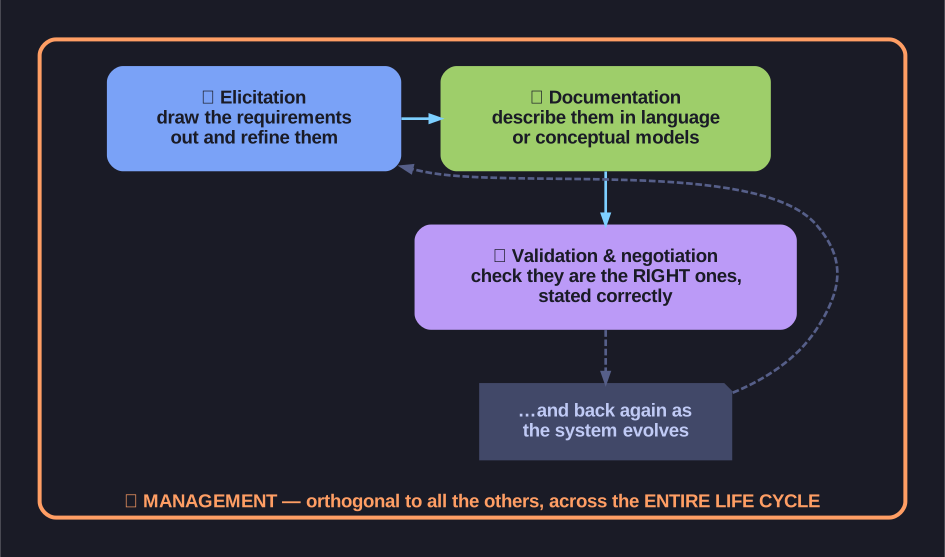
* Management is drawn as the band around the other three, not as a fourth step in the queue — that is what orthogonal means here. *
Pohl's classic formulation states it as one sentence: during the development process, requirements engineering must elicit the stakeholders' requirements, document them in a suitable manner, validate and verify them, and manage them across the entire life cycle of the system. Broken out, the four are:
- Elicitation — actively draw the requirements out of stakeholders and other sources, then refine them in greater detail. (They rarely arrive fully formed; you have to dig, using different techniques for different sources.)
- Documentation — describe the elicited requirements adequately, using natural language or conceptual models, so they can be communicated and checked.
- Validation and negotiation — check the documented requirements early against predefined quality criteria and negotiate the conflicts. Validation asks "are these the right requirements — what the stakeholders actually want?"; verification asks "are they stated correctly — clear, consistent, testable?"
- Management — everything needed to structure the requirements, prepare them so different roles can use them, maintain consistency after changes, and ensure they are implemented.
The framing worth remembering is that management is orthogonal to the other three, not the fourth step in a queue: it runs alongside elicitation, documentation and validation for as long as the system lives, which is exactly what "entire life cycle" is doing in the definition. Treating requirements engineering as a one-off front-loaded phase is the classic mistake — requirements are consulted, challenged and revised through design, build, test and evolution, so change management of requirements is part of the job to the very end.
Tip: The four labels vary slightly by source — ISO/IEC/IEEE 29148 phrases them as Elicitation, Documentation, Validation & negotiation, and Management — but it is the same skeleton, and the load-bearing phrase in every version is entire life cycle.
Go deeper:
 Requirements engineering (Wikipedia) — the activities set out with their standard variants and history.
- Verification and validation (Wikipedia) — the "right requirements" versus "requirements stated right" distinction, in depth.